



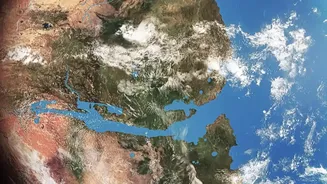
A New Era of Planetary Discovery
For centuries, our view of the cosmos was limited to the planets within our own solar system. However, in recent decades, astronomers have confirmed the existence of thousands of planets orbiting other stars, known as exoplanets. The ultimate goal is to find
one that is truly Earth-like: a rocky planet, similar in size to our own, orbiting within its star's 'habitable zone'. This is the region where conditions are just right for liquid water to potentially exist on the surface—a key ingredient for life as we know it. While finding planets in this zone is the first step, it doesn't guarantee habitability. The crucial next step, which was previously beyond our reach, is to determine if these planets have atmospheres and, if so, what those atmospheres are made of.
The Science of Starlight and Shadows
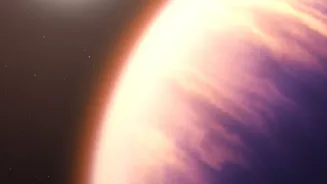
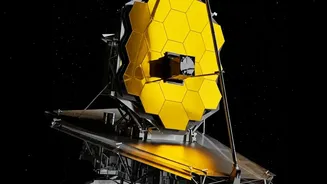
This is where the James Webb Space Telescope's groundbreaking technology comes into play. JWST's primary method for analyzing an exoplanet's atmosphere is called transmission spectroscopy. The process is conceptually simple but technologically immense. When an exoplanet passes in front of its host star from our perspective—an event called a 'transit'—a tiny fraction of the starlight filters through the planet's atmosphere. The gases present in that atmosphere absorb specific wavelengths, or colors, of light. This leaves a unique chemical fingerprint, or 'barcode,' imprinted on the starlight that reaches the telescope. By analyzing which colors are missing from the star's light spectrum during a transit, scientists can deduce precisely which atoms and molecules are present in the exoplanet's atmosphere.
Hunting for Atmospheric Biosignatures
The search for Earth-like planets is fundamentally a search for life, and JWST is hunting for 'biosignatures'—gases that could indicate biological processes. Key targets include water vapor, a prerequisite for life as we understand it, and methane, which can be produced by living organisms. Detecting a combination of gases, such as methane and carbon dioxide together, could be a particularly strong sign of life. On Earth, the coexistence of these gases is maintained by a constant cycle of production by living things and geological processes. Finding a similar disequilibrium on a distant world would be a compelling, though not definitive, piece of evidence. The telescope has already successfully detected water vapor, carbon dioxide, and methane in the atmospheres of various exoplanets, including the candidate 'Hycean' world K2-18b, demonstrating its remarkable capabilities.
A Complex and Cautious Search
The process of identifying these signals is incredibly challenging. The atmospheric signal from a rocky exoplanet is exceptionally weak, often buried in the noise from its host star and instrumental effects. Scientists must observe multiple transits of the same planet to gather enough data to be confident in their findings. Furthermore, interpretation is complex. Many gases that could be biosignatures can also be produced by non-biological processes, such as volcanic activity or photochemical reactions. For example, an initial tantalizing signal of water vapor on the rocky exoplanet GJ 486 b was later questioned, with follow-up observations suggesting the planet may have little to no atmosphere at all. This highlights the rigorous and cautious nature of the scientific process; every potential detection must be scrutinized and verified.
From Data to Understanding
The data from JWST is not a simple 'yes' or 'no' answer. It provides a spectrum that requires complex computational models to interpret. Scientists compare the observed data to various atmospheric models to find the best fit, a process known as atmospheric retrieval. This can sometimes lead to different interpretations of the same data, as seen with planets where initial findings are debated and refined over time. The goal isn't to find a single 'silver bullet' gas but to build a complete picture of the planet's atmospheric context. Even with its incredible power, characterizing these distant worlds is an intricate task that pushes the boundaries of our scientific understanding and modeling capabilities.