




A Fiery Welcome to Mercury
Getting into orbit around Mercury is one of the most difficult feats in space exploration. A spacecraft must constantly brake against the Sun's immense gravity, which tries to pull it into a faster orbit. To slow down, BepiColombo executed a complex series
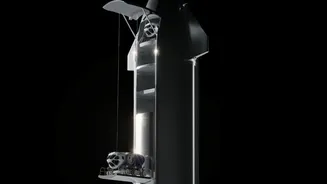
of nine planetary flybys—one of Earth, two of Venus, and six of Mercury itself—using gravity to shed speed over its long journey. The final critical steps began on September 3, 2026, with the successful separation of the Mercury Transfer Module, the propulsion unit that powered the voyage. The two science orbiters are now set for their orbital insertion in November 2026, marking the end of a long trip and the beginning of an intense period of discovery at the solar system's innermost planet.
Two Probes, One Mission
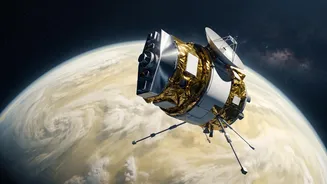
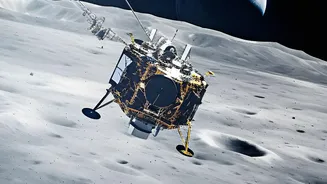
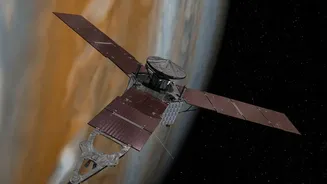
BepiColombo is not one spacecraft, but two. For the first time, two probes will orbit Mercury simultaneously, providing complementary views of the planet. The European Space Agency's (ESA) Mercury Planetary Orbiter (MPO) will fly in a low orbit, focusing on mapping the planet's surface and interior. Meanwhile, the Japan Aerospace Exploration Agency's (JAXA) Mercury Magnetospheric Orbiter, named Mio, will take a wider, elliptical orbit to study the planet's magnetic field and its interaction with the solar wind. Observing from two different points will allow scientists to distinguish between phenomena originating from the planet and those caused by the Sun, a crucial advantage for untangling Mercury's complex environment.
Solving Mercury’s Greatest Mysteries
Mercury is a planet of extremes and contradictions that previous missions, like NASA's MESSENGER, only began to uncover. BepiColombo aims to answer several key questions. Why is Mercury so dense, with an iron core that makes up a huge proportion of its mass? What is the origin of its mysterious magnetic field, which is oddly offset from the planet's center? And what are the strange, bright pits known as "hollows" that dot its surface? MPO's suite of 11 instruments, including high-resolution cameras, spectrometers, and a laser altimeter, will map the surface in unprecedented detail, searching for clues about its geological history and composition.
Mio: Surfing the Solar Wind
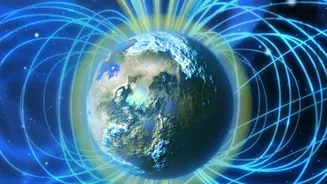
JAXA's Mio orbiter has a very specific and challenging job: to study Mercury's magnetosphere. Unlike Earth's robust magnetic shield, Mercury's is weak and much closer to the planet, offering a unique laboratory for understanding planetary magnetic fields. Mio will dive through this dynamic environment, measuring the plasma, particles, and waves created by the relentless solar wind bombarding the planet. One of its key instruments, the Mercury Sodium Atmosphere Spectral Imager, will investigate the planet's incredibly thin atmosphere, or exosphere, to understand how it is generated and maintained so close to the Sun. This data will help scientists understand not just Mercury, but also the space weather that affects planets across the solar system, including Earth.
Searching for Ice in the Shadows
It may sound impossible on a planet where surface temperatures can reach 430°C, but scientists believe there could be water ice hidden on Mercury. This ice is thought to exist in permanently shadowed craters near the planet's poles, regions that the Sun's scorching rays have never touched. NASA's MESSENGER mission found compelling evidence for these polar ice deposits, and BepiColombo's MPO will follow up with more advanced instruments. The probe will aim its BepiColombo Laser Altimeter (BELA) into these dark craters to precisely measure their depth and reflectivity, hoping to confirm the presence and quantity of water ice. This could provide vital clues about how water and other volatile compounds were distributed throughout the early solar system.
The Timeline for Discovery
The mission's arrival is a multi-stage process. After orbital insertion in November 2026, the two connected orbiters will perform final checks. The crucial separation of MPO and Mio is scheduled for December 2026. Following this, each orbiter will maneuver into its final planned science orbit. The primary science mission is set to begin in earnest in April 2027 and is planned to last for at least one Earth year, with a possible one-year extension. As data begins to stream back, scientists expect an explosion of new results, transforming our understanding of this enigmatic world.