





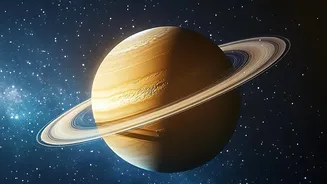


Why October Is Prime Time For Stargazers
This month is special because Saturn reaches opposition on October 4. Opposition is an astronomical event when Earth passes directly between the Sun and an outer planet, in this case, Saturn. Think of it as a celestial alignment that puts Saturn on the opposite
side of the sky from the Sun. This means the planet rises around sunset, stays visible for most of the night, and sets near sunrise. This alignment also means Saturn is at its closest point to Earth for the year, making it appear at its brightest and largest from our perspective. While the peak is around October 4, the planet will remain exceptionally bright and easy to spot throughout the month.
Know What You're Looking For
To the naked eye, Saturn won't look like the stunning images from space probes. Instead, it will appear as a bright, star-like point of light. The key difference between spotting Saturn and a star is the quality of its light. Stars tend to twinkle because their light is distorted by our atmosphere, but planets like Saturn shine with a more steady, unwavering glow. Look for a bright, non-twinkling object with a distinctly pale golden or off-white hue. At a brightness of magnitude 0.3, it will be one of the most brilliant objects in its patch of the sky.
Step 1: Find the Right Time and Place
The best part about Saturn's opposition is its all-night visibility. You can head out shortly after sunset to see it rise in the east, watch it climb to its highest point in the southern sky around midnight, or catch it before it sets in the west at dawn. For the sharpest view, wait until the planet is higher in the sky, away from the turbulent air near the horizon. You don't need to escape to the countryside, as Saturn is bright enough to cut through city light pollution. However, for the best experience, find a spot away from the direct glare of streetlights or buildings. Give your eyes about 15-20 minutes to adjust to the darkness; this will make it much easier to pick out celestial objects.
Step 2: Locate the Planet in the Sky
This October, Saturn will be located in the constellation Cetus (the Whale), near its border with Pisces. Don't worry if you're not a constellation expert. This area of the sky doesn't have many bright stars, which makes Saturn stand out even more. A great landmark to use is the Great Square of Pegasus, a large, easily identifiable square of four bright stars. Look to the east after dark and you'll find Saturn shining below this giant celestial square. As it moves across the sky through the night, it will remain the brightest point of light in its immediate vicinity, making it your anchor point.
Step 3: A Few Extra Tips for Success
Patience is key. Take your time scanning the southeastern sky after dusk. Once you've located the Great Square of Pegasus, look below it for the steady, golden light you now know is Saturn. Using a stargazing app on your phone can be a helpful confirmation, but try to find it with your own eyes first for a more rewarding experience. The Moon will be in a favorable phase during the early part of the month, meaning its light won't wash out the sky around the time of opposition. If you happen to have a pair of binoculars, they can enhance the view slightly by revealing Saturn as a tiny, elongated oval, though you won't be able to distinguish the rings. Seeing the rings themselves requires a small telescope.