




The Surprising Observations
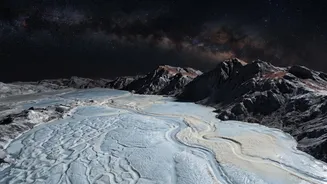
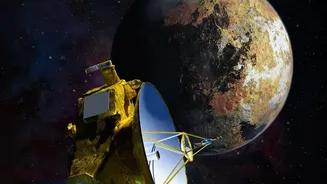
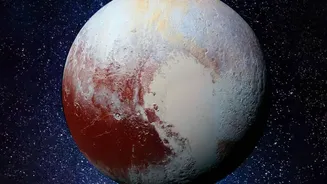
When NASA’s New Horizons spacecraft flew past Pluto in 2015, it revealed a world far more complex than a simple ball of ice. Among the most stunning features was Sputnik Planitia, the western lobe of Pluto's famous heart-shaped region, a vast glacier
made primarily of frozen nitrogen. A 2026 analysis of images from this mission provided the first evidence of what appears to be recently flowing liquid on Pluto's surface. Researchers noticed dark streaks and patches along the northern edge of the glacier that look remarkably similar to areas on Earth's own ice sheets that have been wetted by liquid water. Since Pluto's frigid conditions, with surface temperatures around -220 degrees Celsius, make nitrogen rain impossible, scientists had to look for another explanation.
Theory 1: Flowing Liquid Nitrogen
The leading theory for these dark surface features points to liquid nitrogen. But if it’s not raining from the sky, where is it coming from? Computer models suggest that heat radiating from Pluto's rocky core could be just enough to melt the nitrogen ice at the very bottom of the kilometers-deep Sputnik Planitia glacier. This liquid nitrogen, being less dense than the solid ice above it, would then be buoyant. It could be forced upward through cracks and conduits in the ice, similar to how magma rises through rock on Earth. Once on the surface, this liquid nitrogen could flow briefly before refreezing, darkening the ice and creating the patterns observed by New Horizons. This suggests Pluto is geologically active, a surprising trait for such a small, distant world.
Theory 2: A Deep Subsurface Ocean
Beyond flowing nitrogen, there is compelling evidence that Pluto harbors a vast ocean of liquid water deep beneath its icy shell. The idea first gained traction when New Horizons revealed massive tectonic features—long, deep faults indicating that Pluto's surface had been stretched. Scientists believe that if Pluto once had an inner ocean that froze solid, the planet would have shrunk. Instead, the evidence points to expansion, which would happen if a subsurface ocean were still in the process of freezing, or being maintained in a liquid state. This ocean is thought to exist under an ice shell 40 to 80 kilometers thick. Heat from the decay of radioactive elements in Pluto's core could be sufficient to keep this water from freezing entirely.
Theory 3: Cryovolcanism's Slushy Eruptions
Another process that could mimic liquid activity is cryovolcanism, or ice volcanoes. Instead of molten rock, these volcanoes would erupt a cold, slushy mixture of water ice, ammonia, and methane. The presence of ammonia on Pluto's surface is a key piece of evidence, as the compound is fragile and would be destroyed over time by solar radiation if not replenished. Its presence suggests it was deposited relatively recently. Formations like Wright Mons and Piccard Mons, massive mounds with deep central depressions, have been identified as potential cryovolcanoes. These features appear geologically young, with very few impact craters, suggesting they were formed by recent eruptions of an icy slush that flowed across the surface before freezing solid.