





Hearing the Light
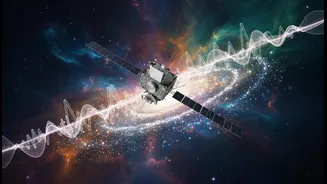
While space is a vacuum and doesn't carry sound, NASA has found a way to let us listen to the cosmos. The process is called data sonification, and it's the auditory equivalent of data visualization. Instead of turning the digital ones and zeroes from
a telescope into a breathtaking image, scientists translate that same data into sound. A team of astrophysicists, musicians, and visualization scientists collaborates on this process. They assign different properties of astronomical images, like brightness, color, or position, to musical elements such as pitch, volume, and duration. A bright star might become a loud note, while the faint gas of a nebula might be represented by a softer, sustained tone.
From Pictures to Pitch
This isn't just a random assignment of notes. The process is a careful translation that preserves the scientific information within the data. For example, in sonifications of images from NASA's Chandra X-ray Observatory, different colors representing various X-ray energy levels can be mapped to distinct tones. Similarly, data from the James Webb and Hubble Space Telescopes are transformed into rich soundscapes. In one sonification of a galaxy, X-ray data from Chandra might be represented by clear, plucked sounds, while infrared data from Webb becomes lower, ambient tones, and the visible light from Hubble is turned into breathy synthesizer sounds. As a cursor or line sweeps across the visual image, you hear the data points it encounters, creating an ethereal symphony of science.
More Than Just Cosmic Music
The goal of NASA's sonification project isn't just to create beautiful music; it has profound scientific and accessibility benefits. For scientists, listening to data can reveal patterns, anomalies, or details that are difficult to spot in a purely visual format. Just as a doctor might listen for a heart murmur, an astrophysicist can listen for subtle variations in cosmic data. More importantly, this project opens up the wonders of astronomy to new audiences. It was designed with the blind and low-vision community in mind from the outset, providing a way to experience the beauty and complexity of astronomical images and data that was previously inaccessible. It transforms astronomy from a predominantly visual field into a multisensory experience for everyone.
Where to Tune In
NASA has made these cosmic compositions widely available. A growing collection of sonifications from missions like Chandra, Webb, and Hubble can be found on NASA's website and its dedicated pages for the project, sometimes called NASA's Universe of Sound. Many of the audio tracks, including sonifications of famous objects like the Pillars of Creation, the galactic center, and various nebulae and star clusters, are posted on YouTube and SoundCloud. The agency has also released a documentary called “Listen to the Universe” on its NASA+ streaming service, which goes behind the scenes of the project. These resources are generally free to access, with NASA encouraging the public to listen, download, and even get creative with the sounds of space.