


Cosmic Crashes and Stellar Baby Booms
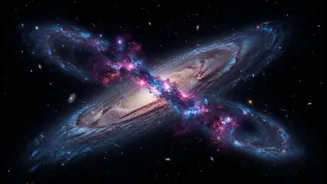
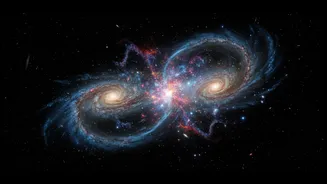
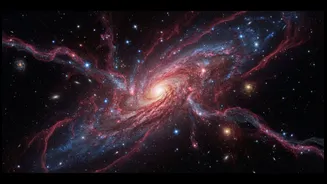
Imagine two cities, each with billions of inhabitants, slowly drifting towards each other over millions of years until they merge into one chaotic megapolis. In space, this happens with galaxies. A galaxy merger is a colossal event where two or more galaxies,
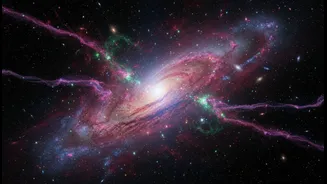
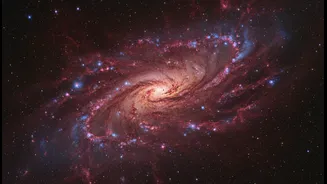
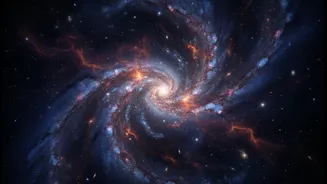
drawn together by gravity, collide and combine. While individual stars rarely hit each other due to the immense space between them, the gravitational forces at play are transformative. These interactions violently churn and compress the vast clouds of gas and dust within the galaxies. This compression triggers a furious, galaxy-wide wave of star formation known as a 'starburst'. For a time, the new, merged galaxy blazes with the light of millions of newborn stars, an event that can outshine all others in its cosmic neighborhood.
The Old Story: A Short, Violent Life
For decades, astronomers believed these starburst phases were like cosmic fireworks: intensely brilliant but tragically short-lived. The thinking was that a galactic merger would quickly use up all available gas for star-making, or that the resulting energy from the starburst and the galaxy's active central black hole would blow the remaining gas away. This would 'quench' the galaxy, abruptly shutting down star formation and leaving it to slowly fade. In this model, the 'lifespan' of a starburst was a brief, frantic period before the galaxy settled into a quiet, inactive retirement. Telescopes like Hubble could see the aftermath, but the dust and gas from the collision itself often obscured the crucial, messy details of what happened during the merger.
A New Eye on the Universe
Enter the James Webb Space Telescope (JWST). With its powerful infrared vision, Webb can peer through the dense veils of cosmic dust that were impenetrable to older telescopes. It's like having a pair of X-ray glasses for the cosmos, allowing scientists to see the hidden structures and processes at the heart of these galactic collisions. Recent observations have focused on galaxies in the early universe, a period known as 'cosmic noon' when star formation was at its peak. By looking at galaxies that had recently gone through mergers and starbursts, astronomers hoped to find definitive clues about why and how they stop forming stars.
Rewriting the Cosmic Clock
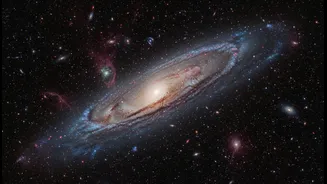
What Webb discovered has added a crucial twist to the story. While studying nearby and distant merging galaxies, like Centaurus A and others in the early universe, the telescope revealed that the process is far more complex. Instead of a simple, quick burnout, the mergers leave behind faint, hidden scars and disturbances that tell a tale of a violent past. More importantly, Webb's data suggests the connection between mergers, starbursts, and quenching isn't as straightforward as once believed. Some discoveries show mergers happening much earlier in the universe's history than predicted, triggering intense star-making that was both powerful and widespread. Other findings indicate that while a merger does indeed trigger a starburst, the process of shutting down star formation can be a two-way street. The galaxy's central black hole can both trigger star birth by compressing gas and stifle it by blasting material away. This alters the 'lifespan' of a starburst from a simple on/off switch to a more nuanced dimmer switch, influenced by a complex interplay of forces.
Why This Discovery Matters
This new understanding fundamentally changes our models of how galaxies evolve. If starbursts aren't just a brief flash in the pan, it means massive galaxies could have formed and matured differently than we thought. The latest findings suggest that violent mergers were a key mechanism for shutting down star formation in the massive galaxies of the early universe. However, Webb has also shown that even after the main event, the process of settling down is long and leaves behind tell-tale signs. By studying these remnants, scientists can reconstruct the timeline of these cosmic events with far greater accuracy. This helps explain the diversity of galaxies we see today, from brilliant star-forming spirals to massive, quiescent elliptical galaxies. Understanding the true lifecycle of a starburst helps us piece together the history of the entire cosmos, from the chaotic early years to the more structured universe of the present day.