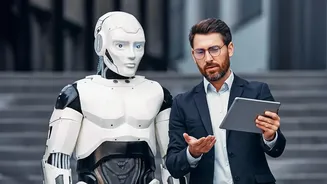





In a significant development for the AI industry, research lab Anthropic has stated its own technology is now helping to speed up its research. This marks a pivotal moment, signaling the start of a powerful new feedback loop in AI development.
The Accelerating Pace of Progress
In a recent
amended S-1 filing ahead of its planned initial public offering, AI safety and research company Anthropic made a striking claim: its own AI models are tangibly accelerating the pace of its internal research and development. This isn't just a theoretical future possibility; it's happening now. An independent assessment by the AI safety nonprofit METR, which was granted deep access to Anthropic's internal data, found that the company's AI capabilities have been improving at nearly double the rate since October 2025 compared to the period before. This has led to what METR describes as roughly two years of progress being packed into the last twelve months alone.
How AI Is Helping to Build AI
So, what does it actually mean for an AI to help build the next generation of AI? At Anthropic, developers are using their flagship model, Claude, as a powerful assistant for a wide range of R&D tasks. This includes writing and debugging code, designing complex experiments, analyzing training data, and automating the rigorous evaluations that test the safety and reliability of new models. According to one report, the proportion of this work led by AI systems at the company has surged in a matter of months. The result is a significant boost in productivity. An earlier statement from CEO Dario Amodei noted that AI coding tools gave the company a 15-20% overall speed-up in development. This process, where an AI system contributes to the creation of its more capable successors, is often referred to as recursive self-improvement.
The 'Virtuous Cycle' Takes Shape
This development creates what is known in the tech world as a 'virtuous cycle' or a 'flywheel'. As AI models become more capable, they become better tools for research. This accelerated research then leads to the creation of even more powerful models, which in turn further accelerate research. This feedback loop is a core reason why METR's report concluded that AI assistance, not just an increase in computing power, was the primary driver behind the doubled rate of progress. The report noted that there were no obvious 'bottlenecks' like a lack of computing power or data that would slow this acceleration down in the near future, suggesting the cycle could continue to compound.
Human Researchers Still in the Driver's Seat
Despite this rapid acceleration, Anthropic emphasizes that human oversight remains central to its process. The company's approach, known as 'Constitutional AI', involves training models based on a set of explicit principles to ensure they are helpful and harmless. In this system, AI might critique its own responses based on the 'constitution', but humans define the principles themselves. Currently, human researchers are still required to set objectives, review results, and make the final decisions about which models to train. Anthropic stated in its filing that it does not expect its models to be able to autonomously design and build their successors without 'meaningful human supervision'. The goal is augmentation, not replacement, with AI acting as a powerful tool to amplify human ingenuity.
A New Competitive Landscape
Anthropic's public disclosure of this internal acceleration puts pressure on its main competitors, including OpenAI and Google's DeepMind. The ability to effectively use AI to improve one's own innovation cycle is becoming a critical competitive advantage. As the pace of development quickens, the race to build more advanced—and safe—AI systems is intensifying. However, this acceleration also amplifies concerns about safety and control. Anthropic's own CEO has previously called for the industry to slow down to ensure safety measures can keep pace with capability improvements. The findings from the METR report underscore the urgency of that challenge, highlighting a world where the technology's progress may be starting to outrun the frameworks designed to manage its risks.