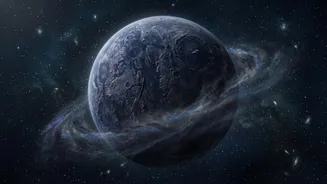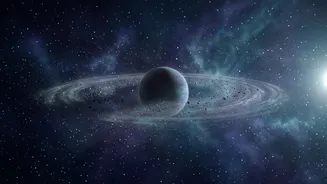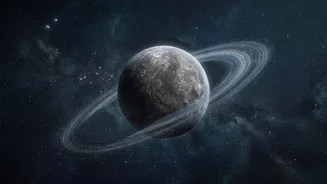

Imagine discovering a new planet, only for it to perform a cosmic magic trick and disappear. That's what happened with Fomalhaut b, an object that baffled astronomers for years. Now, new findings reveal the ghost in the machine.
The Ghostly Planet Appears
In 2008, the world of astronomy
was buzzing. Using the powerful vision of the Hubble Space Telescope, scientists announced the first-ever direct images of a planet outside our solar system, or exoplanet, orbiting the bright star Fomalhaut, just 25 light-years away. They called it Fomalhaut b. It appeared as a distinct point of light, seemingly on a path around its star. It was a landmark discovery, offering a rare glimpse of a distant world. However, right from the start, Fomalhaut b was a puzzle. It was incredibly bright in visible light, which is unusual for an exoplanet, yet it gave off almost no infrared heat. A young, massive planet should be warm enough to glow in the infrared spectrum. This anomaly was the first clue that something was not quite right.
The Great Disappearing Act
The plot thickened as astronomers continued to track the mysterious object. When researchers, led by András Gáspár and George Rieke of the University of Arizona, re-examined years of Hubble data, they made a startling discovery. In images taken in 2014, Fomalhaut b had vanished completely. A planet, especially one thought to be several times the mass of Jupiter, can't just disappear. As Gáspár noted, the object was clearly 'doing things a bona fide planet should not be doing'. Analysis of earlier images showed it had also been slowly fading and expanding over time, behaving less like a solid planetary body and more like a dispersing cloud. The cosmic detective story had a new, central mystery: how do you explain a planet that vanishes into thin air?
Cosmic Detectives on the Case
The new, definitive explanation is as dramatic as it is elegant: Fomalhaut b was never a planet. Instead, what the Hubble telescope witnessed was the immediate aftermath of a titanic collision between two massive, icy bodies orbiting the star. The researchers calculated that two planetesimals, each likely around 200 kilometres in diameter, had smashed into each other shortly before the first observations in 2004. This incredibly rare event—estimated to occur in a mature system like Fomalhaut only once every 200,000 years—created a vast, expanding cloud of extremely fine dust particles. This cloud was dense enough at first to reflect starlight and mimic the appearance of a planet.
A Cloud of Icy Dust
The collision theory perfectly explained all of Fomalhaut b's strange behaviours. The cloud's brightness in visible light was due to sunlight scattering off a huge surface area of tiny dust particles, each about 1/50th the diameter of a human hair. The lack of an infrared signature made sense because the dust cloud was incredibly cold, unlike a heat-generating planet. Its gradual fading was the result of the dust cloud expanding and becoming more diffuse over time. By 2014, the cloud had spread out so much—to a size larger than Earth's orbit around the sun—that it fell below Hubble's detection limit, effectively vanishing. The object was also on a trajectory that appeared to be escaping the star system, which would be impossible for an orbiting planet but expected for a dust cloud being pushed by the pressure of starlight.
Why Phantom Planets Matter
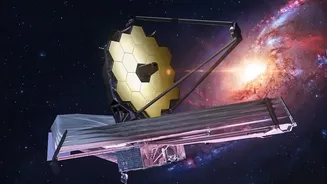
While Fomalhaut b may not be the planet we once thought, its story is arguably more significant. Witnessing the aftermath of such a massive collision provides a rare and valuable glimpse into how planetary systems evolve. It is a 'blueprint of how planets destroy each other', according to Rieke. These cataclysmic events are a fundamental part of planetary formation, shaping the architecture of solar systems. The discovery also serves as a crucial lesson for future planet-hunting missions. It shows that not every point of light near a star is a planet; sometimes, it's a temporary ghost created by cosmic violence. As telescopes like the James Webb Space Telescope search for distant worlds, astronomers will now be more aware that they might be catching these fleeting, planet-impersonating dust clouds.