




A Sleeping Giant in Every Galaxy
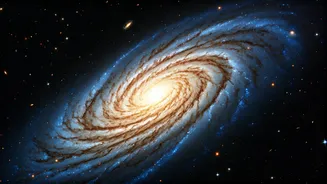
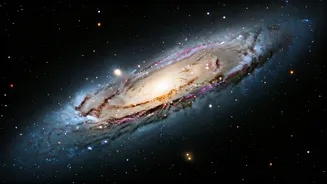
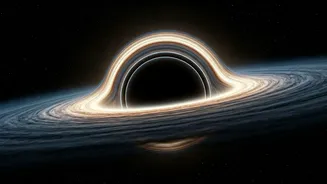
Imagine an object with the mass of millions or even billions of suns, compressed into a space smaller than our solar system. That is a supermassive black hole (SMBH), and astronomers believe one resides at the center of most massive galaxies. For much
of a galaxy's life, this central black hole is dormant, or 'sleeping'. It quietly co-exists with the billions of stars swirling around it. It's not actively 'eating' large amounts of matter, so its presence is felt mainly through its immense gravitational pull, which anchors the galaxy together.
The Rude Awakening
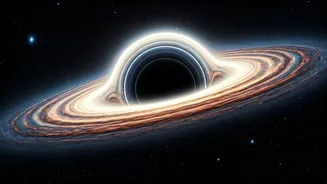
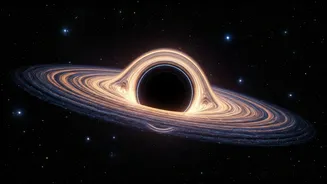
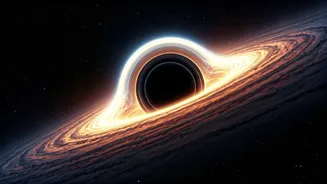
A black hole 'wakes up' when a large supply of gas and dust gets too close. This can happen during a galactic merger or if a large cloud of interstellar gas wanders into the galactic center. As this material is pulled in by the black hole's gravity, it doesn't fall straight in. Instead, it forms a massive, swirling structure called an accretion disk. Frictional forces and intense gravitational effects within this disk heat the material to millions of degrees, causing it to blaze with incredible brightness across the entire electromagnetic spectrum. This 'active' phase turns the galactic center into what astronomers call an Active Galactic Nucleus (AGN), one of the most luminous phenomena in the universe.
Shutting Down the Star Factory
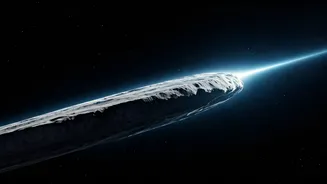
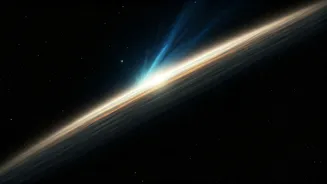
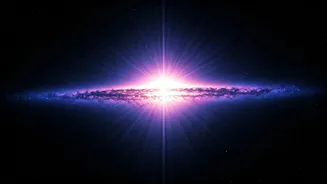
This is where the control comes in. An active black hole is a messy eater. The immense energy released by the accretion disk doesn't just produce light; it drives powerful winds and colossal jets of particles that travel at nearly the speed of light. This process, known as 'AGN feedback', acts like a giant cosmic leaf blower. Stars are born from vast, cold clouds of gas. The energetic winds and radiation from the AGN blast through the galaxy, heating up these cold gas reservoirs or blowing them out of the galaxy entirely. Without this essential raw material, the galaxy's ability to form new stars is drastically reduced or even completely shut down, a process called 'quenching'.
A Galactic Thermostat
This feedback mechanism creates a self-regulating cycle. If too much cold gas flows toward the galaxy's center, it triggers star formation but also 'wakes up' the black hole. The resulting AGN feedback then heats or expels the gas, which shuts down star formation and cuts off the black hole's own food supply, causing it to go dormant again. The cycle can then repeat. In this sense, the supermassive black hole acts as a galactic thermostat, preventing the galaxy from forming too many stars too quickly and shaping its long-term evolution. This explains a long-standing astronomical puzzle: why many massive galaxies, which are full of hot gas that should eventually cool and form stars, are observed to be 'red and dead' with very little new star birth.
Cosmic Detectives at Work
Astronomers can't watch this process unfold in real-time over millions of years, but they can see its effects across the universe. Using powerful instruments like the James Webb Space Telescope and the Chandra X-ray Observatory, they can observe the powerful outflows from AGNs and find 'cavities' in the gas of distant galaxies, which are evidence of a black hole's energetic outburst. By studying galaxies at different stages, they piece together the story of this cosmic relationship. Recent observations have provided strong evidence linking AGN activity directly to the suppression of star formation, confirming that the tiny, central black hole is indeed the master of its vast galactic domain.