



A Celestial Event in Your Favour
The entire month of October is an exceptional time for spotting Saturn, thanks to a celestial alignment called 'opposition' that occurred on October 4. Opposition is when Earth passes directly between the Sun and an outer planet, in this case, Saturn.
For sky-watchers, this is fantastic news for three key reasons: Saturn is at its closest point to Earth for the year, it appears at its brightest, and it is visible for the entire night. It rises in the east around sunset and doesn't set in the west until sunrise, giving you a massive window of opportunity to find it. While the peak was on October 4, the planet moves so slowly that it remains a brilliant target throughout the month.
How to Find the Ringed Planet
Finding Saturn is simpler than you might think. Your first step is to find a spot with a clear view of the eastern horizon, preferably away from the glare of city lights. Shortly after sunset, as the sky darkens, look towards the east. Saturn will appear as a moderately bright point of light rising into the sky. For those in India, the planet will be climbing higher as the evening progresses, reaching its highest point in the sky around midnight before beginning its slow descent towards the west. If you want a helpful landmark, look for a large, four-star pattern known as the Great Square of Pegasus; Saturn will be visible below this celestial marker. You can also use a simple stargazing app on your phone to confirm its location, but your eyes are often all you need.
Star or Saturn? How to Be Sure
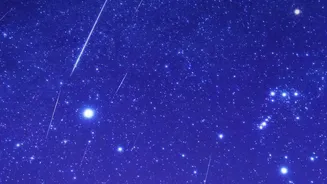
The night sky is filled with bright points, so how do you know which one is Saturn? There are two simple clues. The first is its colour. Saturn shines with a distinct, steady, golden-white or pale-yellowish glow. The second, and most reliable, method is the 'twinkle test'. Stars, which are incredibly distant points of light, appear to twinkle and scintillate because their light is easily distorted by Earth's atmosphere. Planets like Saturn, being much closer, are seen as tiny disks. Their light has a more stable path to your eye, so they shine with a steady, unwavering light. If you spot a bright, yellowish 'star' that isn’t twinkling, you have almost certainly found Saturn.
Don't Be Fooled by Jupiter
Saturn isn't the only bright planet gracing our skies this month, but it is the main attraction in the evening. Its primary competition in brightness is Jupiter, the largest planet in our solar system. However, telling them apart in October is a matter of timing. While Saturn is an all-night object that rises in the evening, Jupiter makes its grand entrance much later. The gas giant rises in the east after midnight, making it a pre-dawn spectacle. So, if you are looking for Saturn in the hours after sunset, you can be confident that the steady, golden light you see is the famous ringed planet and not its brighter cousin.
No Telescope? No Problem
One of the best parts about this celestial opportunity is its accessibility. You do not need any special or expensive equipment to see Saturn. It is one of five planets in our solar system that is bright enough to be easily seen with the naked eye. Looking at it without aid, you will see a bright, star-like point. If you happen to have a pair of binoculars, point them at Saturn. You may notice that it appears as a tiny, slightly elongated oval rather than a sharp point of light; this is the effect of its massive ring system. To actually resolve the rings as separate from the planet, you would need a small telescope. But simply finding it and knowing what you are looking at is a thrill in itself.
The Wonder of What You’re Seeing
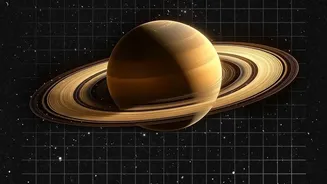
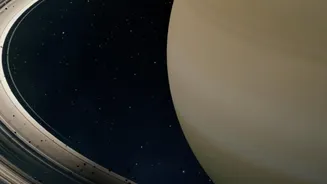
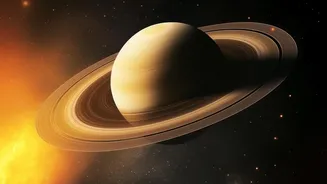
When you finally spot that steady, golden dot, take a moment to appreciate the scale of what you are witnessing. The light from Saturn has travelled for over an hour, crossing more than a billion kilometres of space to reach your eyes. What you are seeing is a giant world, a ball of gas so large that over 760 Earths could fit inside it. And, of course, there are the rings. While invisible to your naked eye, it's magical to know they are there, a vast, shimmering disk of ice and rock. This year's viewing is particularly special, as the rings are once again tilted towards us, making them easily visible in telescopes after they appeared to vanish from sight when they were edge-on in 2025.