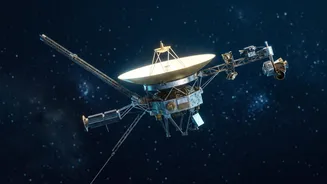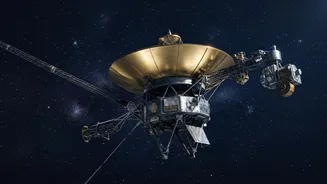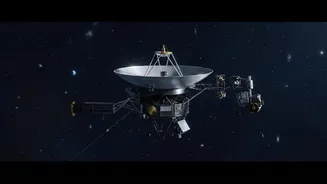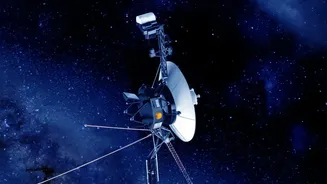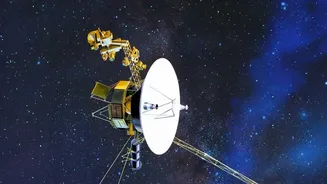



After nearly 50 years sailing through the cosmos, humanity’s farthest envoy, Voyager 1, gave its creators a scare. Following a tense two-day silence in October, NASA has confirmed it is once again in contact with the pioneering spacecraft.
A Faint Whisper From the Void
On October 18
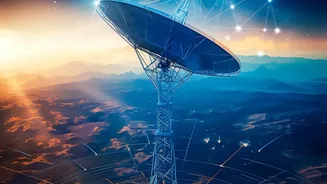
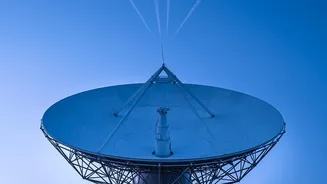
and 19, 2026, scheduled communication attempts with Voyager 1 were met with nothing but silence. For 48 hours, NASA’s Deep Space Network (DSN), a global array of massive radio antennas, strained to hear the faint signal from the probe, which is now an almost unimaginable 25.9 billion kilometres from Earth. Then, on October 20, before the mission team could even send troubleshooting commands, Voyager 1’s signal reappeared. The two-day round trip for any message meant that even diagnosing the problem was a slow and patient process. For the engineers at NASA's Jet Propulsion Laboratory (JPL), the return of the signal was a moment of immense relief.
What Caused the Communications Blackout?
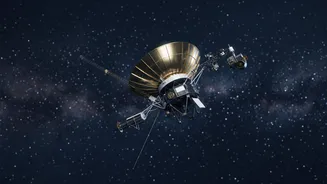
Engineers are still investigating the root cause of the sudden outage, but they have a few key clues. It appears the spacecraft's onboard fault-protection systems automatically triggered a safe mode. The team determined that one group of the probe's thrusters—tiny engines used to keep its main antenna pointed toward Earth—went offline. As programmed, the spacecraft automatically switched to a backup set of thrusters, a maneuver that likely put it into a stable but non-communicative state while it awaited instructions. Mission Manager Kareem Badaruddin noted this was the first time the spacecraft had behaved in this specific way, adding that at this stage of the mission, they have to 'expect the unexpected'.
Humanity's Farthest Emissary
Launched on September 5, 1977, Voyager 1 and its twin, Voyager 2, were initially sent on a 'Grand Tour' of the outer planets. Voyager 1 conducted revolutionary flybys of Jupiter and Saturn in 1979 and 1980, discovering active volcanoes on Jupiter’s moon Io, new planetary rings, and providing the first detailed images of many of our solar system’s giants. In February 1998, it officially became the most distant human-made object in space. Its mission was extended, and in August 2012, it made history by crossing into interstellar space—the region between the stars, beyond the Sun's direct influence. It is the first and only operational spacecraft to directly study this region, sending back invaluable data on the interstellar medium.
An Aging but Resilient Explorer
Keeping a nearly 50 year old spacecraft operational is a testament to engineering ingenuity. Voyager 1 runs on a plutonium based power source that loses about four watts of power each year. To conserve energy, engineers have been methodically shutting down non essential systems and instruments over the years. In September 2026, the team performed a delicate power saving maneuver nicknamed the 'Big Bang', swapping three devices for lower power alternatives to keep the remaining science instruments running for as long as possible. This recent communication glitch is just the latest in a series of age related challenges the probe has overcome, including memory faults and clogged thruster lines.
The successful reconnection with Voyager 1 comes just as the spacecraft is about to reach another incredible milestone. On November 18, 2026, it will be one light day from Earth, meaning its radio signals, traveling at the speed of light, will take a full 24 hours to reach our planet. A simple 'hello' and its reply will take two days to complete. While nothing will physically change for the spacecraft, this milestone underscores the immense scale of its journey and the vastness of space. It continues its lonely voyage, traveling at over $61$,$000$ kilometres per hour,$ carrying with it the 'Golden Record'$—a time capsule of sounds and images from Earth,$ a message in a bottle cast into the cosmic ocean.