




A Journey to an Ocean Moon
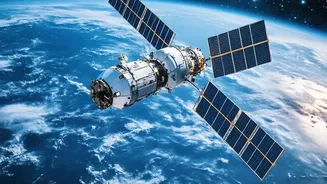
Launched in October 2024, the Europa Clipper spacecraft is currently on a multi-year, 2.9-billion-kilometre journey to the Jupiter system. It is the largest spacecraft NASA has ever developed for a planetary mission. After performing a gravity assist
with Mars in 2025, it is scheduled to perform another with Earth in December 2026 to set its course for arrival at Jupiter in April 2030. The mission's primary goal isn't to land, but to perform nearly 50 close flybys of Europa, some as low as 25 kilometres above the surface. This long, looping orbit around Jupiter allows the spacecraft to repeatedly dip into the harsh radiation environment around Europa to gather data before retreating to safety, a strategy designed to maximise the mission's lifespan and scientific return.
Europa's Intriguing Promise
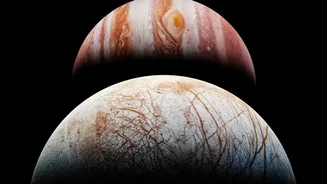
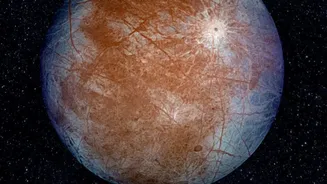
So, why Europa? This moon, slightly smaller than Earth's own, is considered one of the most promising places in our solar system to find the ingredients for life. Scientists have strong evidence that beneath its kilometers-thick ice shell lies a vast, salty ocean of liquid water, potentially containing more than twice the water of all of Earth's oceans combined. Life as we know it requires three key things: liquid water, essential chemical elements, and an energy source. Europa is believed to have all three. The water is there, the chemistry is likely supplied by interactions with a rocky seafloor, and the energy comes not from the sun, but from the immense gravitational tug-of-war with Jupiter, which kneads the moon and warms its interior through tidal heating.
The Advanced Detective Kit
To peer beneath the ice, Clipper is outfitted with a suite of nine sophisticated science instruments. A key tool is the REASON (Radar for Europa Assessment and Sounding: Ocean to Near-surface) instrument, an ice-penetrating radar designed to measure the thickness of the ice crust and locate pockets of water within it. Other sensors will focus on composition. The SUDA (Surface Dust Analyzer) and MASPEX (Mass Spectrometer for Planetary Exploration) will analyze particles and gases, respectively. If Europa vents plumes of water vapour into space from its ocean, as is suspected, these instruments could directly sample the ocean's chemical makeup without ever having to touch down. A magnetometer, PIMS, will measure the strength and direction of the magnetic field around Europa, which will help confirm the ocean's existence and determine its depth and salinity.
Searching for Habitability, Not Aliens
It is important to note that Europa Clipper is not a life-detection mission. Its instruments are not designed to find living organisms. Instead, its primary objective is to assess Europa's habitability. It will investigate whether the conditions are right to support life. By mapping the moon’s geology, confirming the ocean’s properties, and inventorying the available chemical ingredients, the mission will paint the most detailed picture yet of this mysterious ocean world. The findings will be crucial for determining if Europa is a place where life could have started and survived. The data gathered by Clipper will pave the way for future missions that could one day be sent to directly search for signs of life, perhaps even by drilling through the ice to reach the alien ocean below. For now, the world watches as this robotic explorer embarks on one of science's most profound quests.