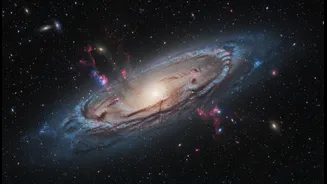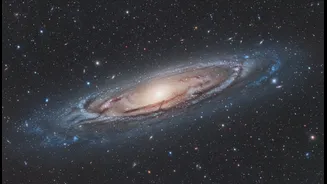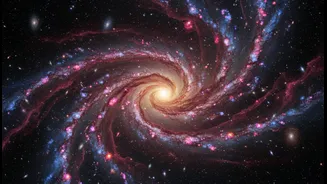



A Tale of Two Galaxies
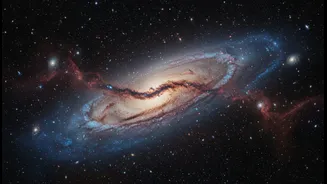
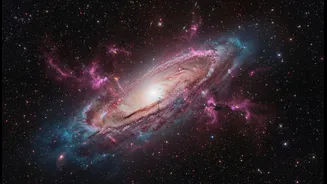
Located about 12 million light-years away, Centaurus A is one of the closest radio galaxies to Earth. For decades, its appearance has puzzled astronomers. It looks like a giant elliptical galaxy that has been wrapped in a thick, dark belt of cosmic dust.
This strange combination is now understood to be the result of a colossal cosmic collision. Sometime in its past, a large elliptical galaxy devoured a smaller, spiral galaxy. The prominent dust lane we see is the messy, lingering wreckage of that galactic merger. In visible light, this dust acts like a curtain, blocking our view of what lies at the galaxy's heart. This is where the special power of infrared astronomy comes into play.
The Power of Infrared Vision
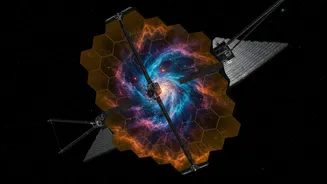
Imagine trying to see through thick smoke. Your eyes, which detect visible light, would struggle. But an infrared camera could cut right through it, detecting the heat of objects hidden within. Infrared light operates on the same principle in space. This longer wavelength of light is not scattered by cosmic dust particles in the same way that shorter-wavelength visible light is. Telescopes like NASA’s now-retired Spitzer Space Telescope and, more recently, the James Webb Space Telescope (JWST), are designed to see in infrared. By capturing this light, they can peer through the dusty veils that shroud galactic cores, star-forming regions, and the environments around supermassive black holes, giving us an unprecedented look at the universe's engine rooms.
Inside the Dusty Wreckage
When infrared telescopes were turned towards Centaurus A, the dark band of dust began to glow. What was once an opaque silhouette resolved into intricate filaments, loops, and glowing clouds of gas and dust. These observations revealed that the dust lane isn't just a simple band; it's a warped, parallelogram-shaped disk of material rotating around the galaxy's center. This twisted structure is a clear scar from the past merger, showing how the gravitational forces of the collision are still shaping the galaxy today. Within this structure, Webb's sharp infrared eye can distinguish millions of individual stars, allowing astronomers to perform a kind of galactic archaeology, figuring out which stars formed before, during, and after the cosmic crash.
A Hidden Stellar Nursery
The galactic collision that scarred Centaurus A also breathed new life into it. The crash compressed vast clouds of gas and dust, triggering a furious burst of star formation. In visible light, these stellar nurseries are completely hidden. But in infrared, these regions blaze brightly. Recent images from the JWST show countless glowing red points, which are either newly forming stars cocooned in dust or older stars shedding their own dusty material back into the galaxy. Infrared light allows astronomers to see the full life cycle of stars within this chaotic environment, witnessing the raw ingredients for future stars and planets being churned and recycled.
Feeding the Central Monster
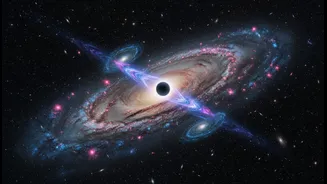
At the very heart of Centaurus A lies a supermassive black hole, weighing in at about 55 million times the mass of our Sun. This black hole is not dormant; it is actively feeding on the gas and dust funnelled towards it by the galactic merger. As material swirls into the black hole, it heats up and shines brightly in infrared light, allowing astronomers to study the process. This feeding frenzy powers colossal jets of particles that shoot out from the nucleus at nearly half the speed of light, extending far beyond the galaxy itself. Infrared spectroscopy from Webb even shows how the black hole's activity influences the surrounding gas, both compressing it to trigger star birth and blasting it away to halt it, revealing the complex interplay between a galaxy and its central engine.