
A Glimpse into the Cosmic Dawn
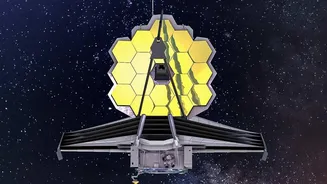
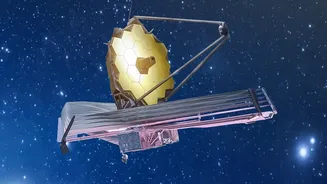
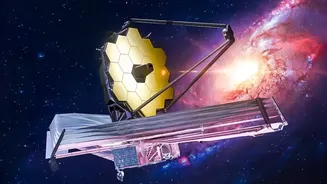
Imagine trying to read the first page of a 13.8-billion-year-old book. That’s essentially the job of the James Webb Space Telescope (JWST). By capturing light that has traveled for billions of years, it allows astronomers to see the universe not as it is
today, but as it was in its infancy. Recent discoveries from programs like the JWST Advanced Deep Extragalactic Survey (JADES) are providing unprecedented views of this era, just a few hundred million years after the Big Bang. What they're finding is shaking up our understanding of how everything began. Instead of a quiet, slowly developing cosmos, the evidence points to a surprisingly active and rapid period of galaxy formation. Galaxies appear to be bigger, brighter, and more complex far earlier than our models predicted.
Galaxies in Overdrive
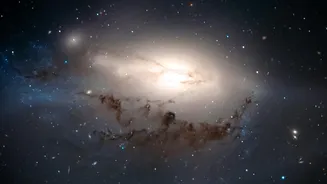
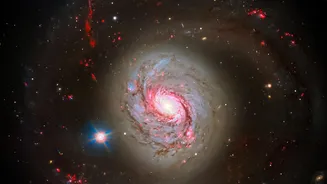
The central surprise from Webb’s observations is the sheer productivity of these early galaxies. They are not just forming; they are churning out stars at an astonishingly high rate. Some of these ancient systems, often called 'starburst' galaxies, are creating stars with an intensity that rivals anything in the modern universe. For instance, the record-breaking galaxy JADES-GS-z14-0, seen as it was just 290 million years after the Big Bang, is remarkably bright and large for its age. Scientists determined its brightness comes not from a central black hole, but from the combined light of massive numbers of young stars, indicating rapid and efficient star formation. This discovery, and others like it, suggest the early universe was far more capable of building large, star-filled galaxies quickly than previously believed.
Webb’s Infrared Superpower
So how does Webb see these distant, ancient objects? The key is its unparalleled sensitivity to infrared light. As the universe expands, the light from the most distant objects gets stretched out, shifting it from visible wavelengths into the infrared spectrum—a phenomenon called redshift. The farther away an object is, the more its light is redshifted. Telescopes like Hubble, which primarily see in visible and ultraviolet light, couldn't capture these faint, stretched-out signals. Webb’s giant mirror and advanced instruments, like its Near-Infrared Camera (NIRCam) and Near-Infrared Spectrograph (NIRSpec), were specifically designed to detect this faint infrared glow. This allows it to pierce through the cosmic dust and distance that once obscured our view, revealing the cradles of the first stars and galaxies in stunning detail.
Rewriting the Cosmic Playbook
These findings are forcing astronomers to rethink long-held theories of galaxy evolution. The standard model suggested that galaxies started small and grew slowly over billions of years through mergers and gradual gas accumulation. However, the presence of massive, highly active galaxies so early in cosmic history suggests a different story. Some galaxies may have formed through more chaotic and turbulent processes, or perhaps they were simply much more efficient at converting primordial gas into stars. Even more intriguing are discoveries of complex structures like galaxy mergers happening just 800 million years post-Big Bang, a level of maturity that wasn't expected for at least another billion years. These observations suggest that the physical conditions in the early universe, from the chemical makeup of gas to the way stars form, might have been very different from what we see today, allowing for this accelerated growth.