




Why Use a Wall for Tree Pose?
Using a prop is not a sign of weakness; it’s a sign of wisdom. The wall is one of the most effective 'teachers' in yoga, providing immediate physical feedback that helps you understand alignment without the fear of falling. For many, the primary challenge
in Tree Pose (Vrikshasana) is balance. By removing that instability, you can shift your focus to the finer details of the posture. This allows you to build strength, refine your hip-opening, and cultivate concentration with confidence. The support of a wall lets you hold the pose for longer, building endurance in the standing leg and a deeper muscular awareness that eventually translates to a steadier freestanding practice.
How to Practice with Wall Support
There are several ways to incorporate the wall. The simplest method is to stand with your side to the wall, about an arm's length away. Place the hand closest to the wall lightly upon it for support. Begin in Mountain Pose (Tadasana), standing tall. Shift your weight onto the foot farther from the wall. Bend your other leg and place the sole of your foot on your inner ankle, calf, or thigh of the standing leg. A crucial safety rule is to never place your foot directly on the knee joint, as this can strain the ligaments. Keep your hips level and facing forward. Actively press your standing leg into your raised foot, and the foot back into the leg, to create a stable connection. Use the wall for as much or as little support as you need.
Perfecting Your Alignment
With the wall handling the balance, you can become a detective of your own alignment. A common mistake in Tree Pose is to 'hike' or lift the hip of the bent leg, which misaligns the pelvis and lower back. Practice with your back against the wall to get a feel for a truly straight spine and level hips. Press your shoulders and sacrum (the flat bone at the base of your spine) against the wall. This helps you notice if you are sinking into your standing hip. From here, engage your core muscles to maintain stability and lengthen your spine, growing tall from the grounded foot all the way to the crown of your head. Your gaze, or 'drishti', is also key. Find a fixed point on the wall in front of you to help calm your mind and sharpen your focus.
Exploring Variations Safely
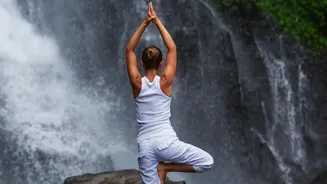
Once you feel stable, the wall becomes a launchpad for exploring different expressions of Tree Pose. With your balance secured, you can play with arm variations. Bring your hands to your heart in a prayer position (Anjali Mudra), or extend them overhead like branches, which challenges your core stability. You could even try 'Cactus Arms' by bending your elbows at 90 degrees to open your chest. Another variation is to rest the knee of your bent leg against the wall, which leaves both hands free. This provides a different kind of support that allows you to feel the full shape of the pose while remaining secure. These explorations help build the muscle memory and confidence needed for more advanced balances.
Progressing to a Freestanding Pose
The goal of using the wall is to eventually outgrow the need for it. Think of it as a set of training wheels. As you become more confident, start to use the wall less. Try just touching it with your fingertips, then maybe just hovering your hand near it without making contact. Notice the muscles you engaged while at the wall—the firm standing leg, the engaged core, the level hips—and work to recreate that same stability in the center of the room. The wall provides a clear blueprint for what a steady, aligned pose feels like. By practicing with it consistently, you are not just preventing falls; you are programming your body for success, making the transition to a freestanding Vrikshasana feel natural and empowered.