








The Tyranny of Interplanetary Distances
Imagine trying to have a video call where every response takes up to 44 minutes to arrive. That's the reality of communicating between Earth and Mars. Depending on the planets' orbits, a one-way signal can take anywhere from three to over twenty minutes to travel
at the speed of light. This immense latency makes real-time control of equipment or accessing Earth-based cloud services impossible for Martian explorers. In an emergency, waiting for instructions from Houston isn't an option. For a colony to be truly autonomous, its critical data infrastructure must be local. This requires a radical shift from our Earth-centric model, where data centers can be accessed from anywhere on the globe, to a decentralized, interplanetary one.
What Is Off-Planet Processing?
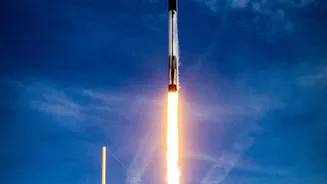
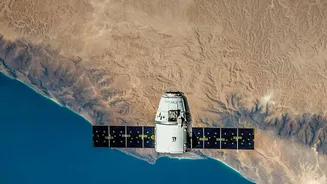
Off-planet processing is essentially 'edge computing' on a planetary scale. Instead of sending raw data back to Earth for analysis, the computation happens right where the data is collected—be it on a satellite, the Moon, or Mars. Elon Musk's proposal focuses on building data centers in space, powered by near-constant sunlight and cooled by the vacuum. These orbital or surface-based data centers would handle everything from running life support systems and navigating rovers to managing the colony's resources. NASA has already recognized the need for this, using edge computing on the International Space Station to reduce data transfer times. For a Martian settlement, this isn't just a convenience; it's a lifeline, providing the necessary computing power for survival and growth without crippling reliance on a distant Earth.
Why Artificial Intelligence is Crucial
A Martian data center wouldn't just be for storage; it would need to be the colony's brain. This is where Artificial Intelligence becomes indispensable. AI systems could manage complex, life-critical tasks autonomously—adjusting atmospheric processors, allocating power, detecting equipment failures, and even assisting with medical diagnostics. Without the ability to rely on millions of experts back on Earth for real-time problem-solving, a Martian colony would need powerful AI to analyze situations and make decisions locally. Musk's statements link the necessity of off-planet data centers directly to the massive computational needs of advanced AI. As AI becomes more integrated into exploration and operations, having the processing power on-site is the only way to make it effective in a high-latency environment.
The 'Starmind' Vision and its Hurdles
SpaceX's ambition is manifesting in projects like 'Starmind', a proposed constellation of orbital data centers. The company has filed applications for a vast number of satellites designed to act as powerful computers in space. The idea is to leverage the reusability of its Starship rocket to make launching this infrastructure economically viable. However, the challenges are immense. Equipment in space must be hardened against cosmic radiation, which can corrupt data. Dissipating the immense heat generated by powerful computer chips in the vacuum of space requires large, heavy radiators. Furthermore, maintaining and repairing this hardware in orbit or on another planet is a complex problem yet to be solved. While Musk is optimistic, even suggesting manufacturing satellites on the Moon from local materials, these remain monumental engineering feats.
The Foundation for a Multiplanetary Future
The conversation around off planet AI processing is about more than just faster computers. It is a fundamental component of making humanity a truly multiplanetary species. Just as railways, power grids, and the internet formed the backbone of civilization on Earth, a network of autonomous, space based data and intelligence infrastructure is seen as a prerequisite for expanding permanently beyond it. This 'interplanetary internet' would not only serve a Martian colony but could also act as a communication and data relay for missions venturing even deeper into the solar system. It represents the digital scaffolding upon which future off world economies and societies could be built, ensuring that as we move farther from Earth, our ability to think, process, and innovate can move with us.