






The Coolest Experiment in Space
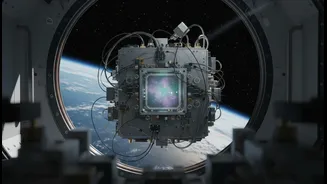
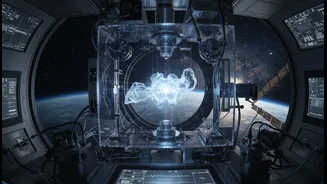
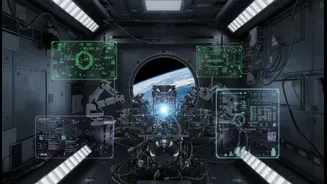
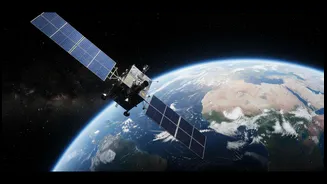
Orbiting 400 kilometers above Earth is NASA's Cold Atom Laboratory (CAL), a quantum physics facility aboard the International Space Station. Launched in 2018, its mission is to study how atoms behave at temperatures colder than anything found in nature,
just a fraction of a degree above absolute zero. At these extreme lows, atoms slow to a crawl and begin to exhibit strange quantum behaviors on a scale large enough to be seen. Controlled entirely from NASA's Jet Propulsion Laboratory on the ground, CAL is a fully automated laboratory designed to push the boundaries of physics.
Beyond Solid, Liquid, and Gas
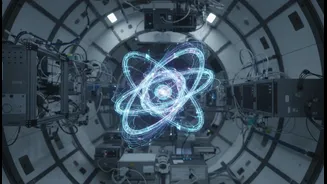
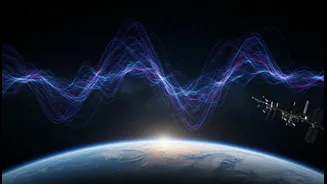
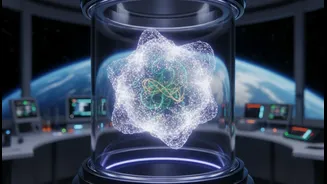
When atoms are cooled to these frigid temperatures using lasers and magnetic traps, they can enter a fifth state of matter: a Bose-Einstein Condensate (BEC). First predicted by Satyendra Nath Bose and Albert Einstein in the 1920s, a BEC is formed when individual atoms overlap and begin to act like a single, massive quantum wave. Instead of behaving like a chaotic crowd, the atoms move in perfect unison, like a disciplined marching band. This allows scientists to directly observe quantum phenomena, which are normally confined to the subatomic world.
Why Space is the Ultimate Laboratory
On Earth, gravity is a major spoiler for these delicate experiments. The force pulls the ultra-cold atoms downward, causing the fragile BEC to collapse in a fraction of a second. Researchers have tried to overcome this with drop towers and rockets, but these only provide a few minutes of freefall at best. The microgravity of the ISS is the game-changer. Without gravity's relentless pull, these quantum states can be maintained for much longer—up to ten seconds or more. This extended observation time is crucial for making the precise measurements needed to test fundamental physics and develop new technologies.
Discoveries from the Quantum Frontier
Since its installation, and with several upgrades, CAL has become a powerhouse of quantum research. Scientists have successfully created BECs from different types of atoms and have even been able to shape them into bubble-like, hollow spheres—a feat impossible on Earth. One of the lab's most significant achievements is using these atoms for interferometry, a technique that uses the wave-like nature of atoms to make incredibly sensitive measurements. This was the first time ultra-cold atoms were used as a sensor to detect changes in their environment in space, measuring subtle vibrations of the space station itself.
The Future of Precision Sensing
The experiments aboard the CAL are more than just academic exercises; they are the foundation for a new generation of quantum sensors. The principles of atom interferometry, honed in space, could lead to navigation systems that don't rely on GPS, allowing submarines and spacecraft to navigate with unprecedented accuracy. These sensors could also measure tiny gravitational fluctuations to find underground water reserves, monitor ice sheets for climate studies, or map the composition of distant planets and moons. In medicine, similar quantum-based sensors could lead to new diagnostic tools that detect faint magnetic signals from the human body.
Probing the Universe's Biggest Mysteries
Beyond practical applications, the Cold Atom Lab is a tool for exploring the cosmos's most profound questions. By observing how different atoms behave in a BEC during freefall, scientists can perform highly precise tests of Einstein's equivalence principle, a cornerstone of general relativity. The extreme sensitivity of these experiments could also provide a new way to search for elusive forces like dark energy and dark matter, which are thought to make up most of the universe but are incredibly difficult to detect. The lab turns the ISS into a unique observatory for the quantum universe.