






A Digital House of Cards
Recent computer simulations have painted a sobering picture of the infrastructure that underpins our modern world. One startling new model from researchers at the University of Wisconsin-Madison and Princeton University simulated the impact of a single,
high-altitude nuclear detonation. The results were catastrophic: within a week, the artificial radiation belt created by the blast would disable approximately 98% of all satellites in low Earth orbit (LEO). The simulation predicted that the loss of manoeuvrability would then lead to about 20 secondary collisions over the next two years as dead satellites crash into one another, creating even more debris. While this is a hypothetical, worst-case scenario, it highlights a critical vulnerability. Our reliance on orbital networks for communication, finance, and navigation has grown exponentially, but the systems themselves remain dangerously exposed.
The Great Traffic Jam in the Sky
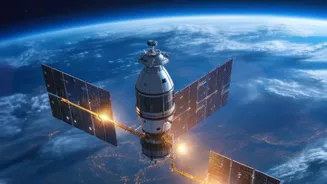
The primary threat isn't just a single catastrophic event, but the slow, creeping danger of orbital congestion. Low Earth orbit is becoming incredibly crowded. In the 2020s, the number of active satellites exploded, largely due to the launch of 'mega-constellations' by private companies aiming to provide global internet. Today, there are over 13,000 active satellites, but they share the sky with tens of thousands of other trackable objects, including defunct satellites, discarded rocket stages, and fragments from past collisions. This ever-growing cloud of space junk dramatically increases the risk of collisions. Each crash creates thousands more pieces of debris, which in turn raise the probability of further collisions. This potential chain reaction is known as the 'Kessler Syndrome', a scenario first described in 1978 that could eventually render entire orbits unusable, effectively trapping us on Earth.
More Than Just Space Junk
While orbital debris is a major physical threat, it is not the only one. The systems that control satellites are also vulnerable. Ground stations, which serve as the control hubs, can be targeted by cyberattacks, potentially allowing malicious actors to send fake commands, shut down services, or even permanently lose control of a satellite. In 2025 alone, 407 cyber operations targeted the space sector, including distributed denial-of-service (DDoS) attacks and ransomware. Furthermore, natural phenomena like solar flares and geomagnetic storms pose an uncontrollable risk. A powerful solar event can damage sensitive electronics, as seen in 2022 when a storm destroyed newly launched Starlink satellites, and again in 2026 with the loss of Indian startup GalaxEye's 'Drishti' satellite.
The Domino Effect on the Ground in India
The fragility of this infrastructure is not an abstract problem; a significant failure would have immediate consequences for daily life in India. The navigation systems used by ride-hailing services, food delivery apps, and for personal travel depend entirely on GPS signals from space. Critical financial infrastructure, including ATM networks and the Unified Payments Interface (UPI), relies on satellite-based time synchronisation. Our military's surveillance capabilities, communication networks, and strategic assets are also deeply integrated with space technology. Recent setbacks in India's own space programme, including the loss of surveillance satellites, have highlighted the challenges and high stakes involved in maintaining these strategic capabilities. A widespread satellite failure would trigger a prolonged degradation of these essential services, impacting everything from national security to the economy.
A Call for Orbital Traffic Control
The simulations serve as a clear warning: the space environment needs to be managed as a critical resource. There is a growing consensus that simply launching more satellites without a plan for their entire lifecycle is unsustainable. Potential solutions are complex and expensive, ranging from developing 'reactive removal services' to capture existing debris to implementing stricter international regulations on satellite design and disposal. Some newer computational models, including those using AI and quantum-assisted algorithms, are being developed to provide faster and more accurate collision forecasting. These tools could help operators perform proactive manoeuvres and reduce false alarms, making operations in crowded orbits safer. Ultimately, ensuring the long-term stability of our space infrastructure will require global cooperation and treating orbital paths with the same seriousness as we do terrestrial highways and shipping lanes.