

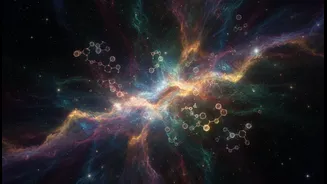
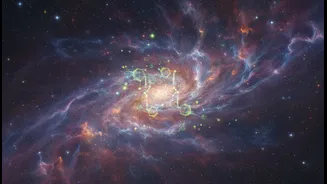


Cosmic Chemical Factories
Deep in space, in the vast, cold clouds of gas and dust where new stars and planets are born, astronomers are finding the pantry is already stocked with life's ingredients. Using powerful tools like the James Webb Space Telescope (JWST) and the Atacama
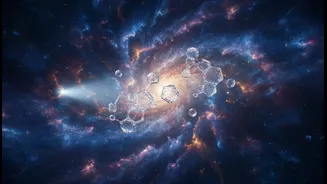
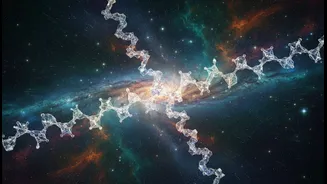
Large Millimeter/submillimeter Array (ALMA), scientists have been identifying a growing list of complex organic molecules that challenge the old assumption that life's chemistry starts on a planet's surface. Discoveries now show that this intricate chemistry begins in the interstellar medium, even before the formation of a star. For the first time, scientists recently reported the direct detection of a sugar molecule, known as erythrulose, in a molecular cloud near the center of the Milky Way. This is significant because sugars form the backbone of RNA and DNA, the very blueprints of life as we know it. Finding them free-floating in the gas that will one day form planets suggests these crucial building blocks don't need to be made from scratch on a young world—they can be inherited.
A Symphony of Molecules
The list of detected molecules is growing more complex and surprising. Astronomers have identified not just simple compounds, but larger ones like dimethyl ether and methyl formate in planet-forming disks. With nine atoms, dimethyl ether was the largest molecule identified in such a disk at the time of its discovery. These molecules are considered precursors to even larger organic structures. Elsewhere, JWST has identified a wealth of carbon-containing molecules, including ethanol (the alcohol in drinks), acetic acid (the acid in vinegar), and methane around infant stars. These are not just random chemicals; they are key players in prebiotic chemistry. Perhaps one of the most pivotal discoveries was the first-ever detection of the methyl cation (CH3+) in the Orion Nebula. This highly reactive molecule is considered a cornerstone of interstellar organic chemistry, readily creating more complex carbon-based molecules, and its confirmed presence helps validate many theories about how organic complexity arises in the universe.
How They Find Them
Detecting these molecules hundreds or thousands of light-years away is a remarkable feat of cosmic detective work. Telescopes like ALMA and JWST don't see the molecules directly. Instead, they detect their unique spectral fingerprints. As molecules rotate and vibrate in space, they absorb or emit light at very specific frequencies. Each molecule has a unique barcode of these frequencies. By capturing the faint light from a distant star-forming region and breaking it down into a spectrum, astronomers can match these patterns to those of known molecules measured in labs on Earth. This has allowed scientists to identify over 200 different kinds of molecules in space, a number that has exploded in recent years thanks to the enhanced sensitivity of new observatories. This process has confirmed the existence of chemicals ranging from simple water and carbon dioxide to complex, ring-shaped polycyclic aromatic hydrocarbons (PAHs), some of which are surprisingly large.
From Cosmic Cloud to New Worlds
The crucial insight from these discoveries is understanding how these ingredients get from the cold depths of space onto a warm, nascent planet. The evidence points to a delivery system via icy dust grains. In the freezing temperatures of a molecular cloud, molecules like water, methanol, and the newly discovered sugars stick to tiny dust grains, forming icy mantles. These cosmic ice-coated pebbles are the building blocks of planets. As the cloud collapses to form a star and a surrounding disk, these icy grains are incorporated into the mix. Scientists have observed how these pebbles can drift from the cold, outer regions of a planet-forming disk toward the warmer, inner regions where rocky planets like Earth form. As they get closer to the star, the ice turns to vapor, releasing its payload of water and complex organic molecules into the atmosphere and surface of the forming planet. This means planets don't start their chemical journey empty-handed; they are seeded with a rich, prebiotic cocktail from the very beginning.