


The Universe's Standard Story
For most of modern astronomy, the Lambda-CDM model has been the accepted standard. This model explains the evolution of the universe from the Big Bang to the present day. It posits that the cosmos is made of ordinary matter, along with two mysterious
components: 'dark matter' and 'dark energy'. Dark matter is thought to be the invisible gravitational glue holding galaxies together, while dark energy is the force driving the accelerating expansion of the universe. Based on observations of the cosmic microwave background (the afterglow of the Big Bang) and the rate of cosmic expansion, this model calculates the age of the universe to be approximately 13.8 billion years. For decades, this has been the bedrock of cosmology.
A Radical New Timeline
Now, a theory advanced by Rajendra Gupta, an adjunct professor of physics at the University of Ottawa, suggests a dramatically different age: 26.7 billion years. This alternative framework, known as the CCC+TL model, proposes a universe that is nearly twice as old as previously thought. The name stands for 'Covarying Coupling Constants plus Tired Light'. This model re-evaluates some fundamental assumptions. Instead of relying on dark matter and dark energy to explain observations, it suggests that their effects could be the result of fundamental physical constants changing over time. It's a bold idea that, if proven, could rewrite our entire understanding of cosmic evolution.
Solving the 'Impossible Galaxy' Problem
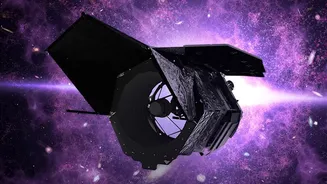
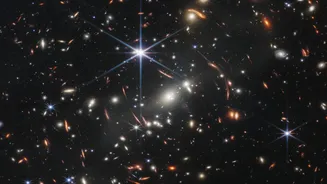
A major motivation for this new model comes from recent discoveries by the James Webb Space Telescope (JWST). The powerful telescope has observed galaxies in the very early universe that appear surprisingly mature and massive. Under the standard 13.8-billion-year model, these galaxies would have formed just a few hundred million years after the Big Bang, which doesn't seem to be enough time for them to have grown so large and structured. This puzzle is known as the 'impossible early galaxy problem'. Gupta's model offers a solution: if the universe is actually 26.7 billion years old, these 'early' galaxies would have had billions of additional years to develop, making their observed maturity entirely predictable.
Tired Light and Evolving Constants
The CCC+TL model combines two key ideas. The first is 'covarying coupling constants', which suggests that the fundamental forces of nature might not be constant over cosmic time. This is paired with a revitalised version of the 'tired light' theory, first proposed by astronomer Fritz Zwicky in 1929. The tired light hypothesis posits that light loses energy as it travels across vast cosmic distances. In this hybrid model, the redshift we observe from distant galaxies isn't just due to the expansion of space, but also from light getting 'tired' on its journey. This combined effect means that light from distant objects took much longer to reach us, significantly extending the calculated age of the universe.
What Does This Mean for Science?
Gupta and his colleague Nikolaos Samaras tested their model against several major astronomical observations between 2025 and 2026. They found it could successfully reproduce the rotation of 175 galaxies without needing dark matter and was consistent with observations of the universe's expansion. However, the model is still new and faces significant scrutiny from the scientific community. Key tests, particularly against the detailed map of the cosmic microwave background, are still needed. While the theory is not yet widely accepted, it represents a crucial part of the scientific process: questioning established models and proposing new ideas to explain puzzling data. It's a reminder that our picture of the cosmos is constantly being refined and challenged.