

Sailing on Sunshine
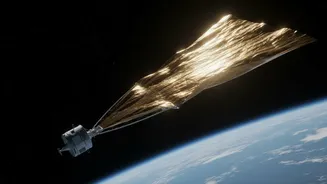
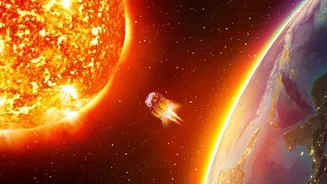
At its core, a solar sail works much like a sailboat on Earth, but instead of wind, it captures the power of sunlight. Light is made of tiny particles called photons. While photons have no mass, they possess momentum. When countless photons from the sun strike
a solar sail's vast, mirror-like surface, they bounce off, transferring their momentum to the sail and giving it a tiny, continuous push. This gentle but constant force is called radiation pressure. In the frictionless vacuum of space, these tiny pushes add up. Over time, this allows a solar sail-powered spacecraft to achieve incredible speeds, potentially far greater than what's possible with conventional chemical rockets that are limited by the amount of fuel they can carry. This technology is propelled by light pressure, not the solar wind, which is a different stream of charged particles from the sun that provides a much weaker force.
What Makes Them 'Next-Gen'?
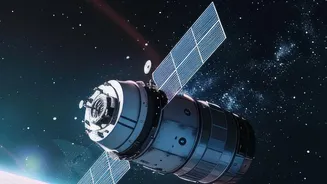
Early missions like The Planetary Society's LightSail 2 successfully demonstrated that solar sailing was a viable concept. Now, next-generation systems are focused on making sails bigger, lighter, and more efficient. The key innovation lies in advanced materials and deployment systems. NASA's Advanced Composite Solar Sail System (ACS3), which launched in April 2024, is a prime example. Instead of heavier metallic booms to unfurl the sail, ACS3 uses lightweight, rollable composite booms made from carbon fiber. These new booms are not only lighter but also more resistant to the extreme temperature changes in space. This technology allows for much larger sails to be packed into very small spacecraft. The ACS3 sail, for instance, is about the size of a small apartment or six parking spaces (80 square meters) but deployed from a satellite the size of a microwave oven. This paves the way for future sails that could be as large as a basketball court or even half a soccer field.
From Theory to Flight
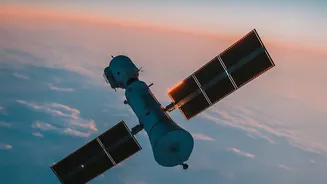
The ACS3 mission is currently in orbit, having successfully deployed its sail to test these new composite booms. Onboard cameras are monitoring the sail's shape and stability as it orbits about 600 miles above Earth, providing crucial data for future designs. The mission also plans to test maneuvers, changing the spacecraft's orbit by angling the sail, similar to how a sailboat tacks in the wind. This demonstration is a critical step. The success of these lightweight booms could enable a new class of ambitious, lower-cost missions. Future applications include positioning space weather warning satellites closer to the sun for earlier detection of solar storms, reconnaissance missions to near-Earth asteroids, and even serving as communication relays for crewed missions to the Moon and Mars.
The Promise and the Peril
The greatest advantage of solar sailing is its potential for near-limitless propulsion without the need for heavy, expensive rocket fuel. This frees up mass and space for more scientific instruments and could enable missions that travel faster and farther than ever before. However, the technology has its challenges. The thrust from sunlight is initially very weak, meaning acceleration is slow. The spacecraft must be incredibly lightweight to be effective. Furthermore, the propulsive force diminishes the farther the spacecraft travels from the sun, making navigation in the outer solar system more difficult. The large, delicate sails are also complex to deploy and control, and they are susceptible to damage. Despite these hurdles, the continuous, gentle push is what makes solar sails a game-changer for long-duration voyages across the cosmos.