






A Junkyard in the Sky
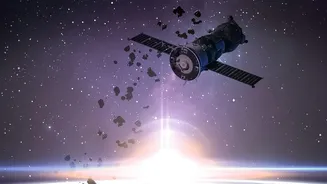
Low Earth Orbit has become a celestial junkyard. Decades of space activity have left a legacy of over 130 million pieces of debris, from defunct satellites and spent rocket stages to tiny fragments from collisions. These objects travel at speeds up to 17,500
miles per hour, turning even a small fleck of paint into a devastating projectile. The risk isn’t just to active satellites providing critical services like GPS and communications; it’s a threat to the International Space Station and future space exploration. Experts warn of the Kessler syndrome, a theoretical scenario where the density of debris becomes so high that collisions cascade, creating an impassable field of junk that could cut off our access to space for centuries.
The Problem with Brute Force
So, how do you catch an object tumbling uncontrollably at hypersonic speeds? Early solutions have focused on brute-force methods. Missions have tested concepts like firing a giant net to ensnare a target or launching a harpoon to spear it. While these methods can work, they come with a significant drawback: they are aggressive. A high-speed impact from a harpoon, for instance, could cause the target to fracture, shattering one large piece of debris into hundreds or thousands of smaller, harder-to-track pieces. This turns a capture mission into a debris-generating event, potentially making the problem worse. These are what engineers call “non-cooperative targets”—objects that weren't designed to be captured and may be spinning unpredictably, making any physical contact risky.
A Gentle, Magnetic Pull
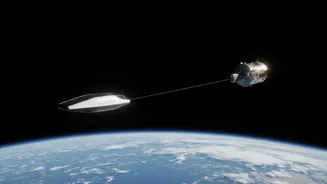
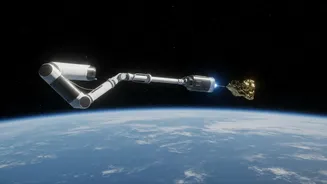
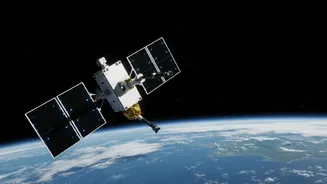
This is where magnetic capture offers a revolutionary alternative. Instead of a violent impact, it uses the fundamental forces of electromagnetism to create a touchless grip. A 'servicer' spacecraft equipped with powerful electromagnets approaches a piece of debris. By generating a changing magnetic field, the servicer can interact with the target from a safe distance. This approach is being pioneered by companies like the Japan-based Astroscale, which has already run successful demonstrations in orbit with its ELSA-d and ELSA-M missions. The goal is to latch onto the junk without physical contact, stabilize its spin, and then gently tow it into a lower orbit where it will burn up harmlessly in Earth's atmosphere.
The Science of Eddy Currents
But wait, you might ask, isn't most space debris made of aluminum, which isn't magnetic? That’s the most clever part of this technology. It doesn't rely on the target being naturally magnetic. Instead, it uses a principle called eddy currents. When you expose a conductive material (like aluminum) to a strong, changing magnetic field, it induces small, circulating electrical currents within the material—the eddy currents. These currents generate their own weak magnetic field, which opposes the original field. This interaction creates a force, a magnetic push or pull, on a non-magnetic object. By precisely controlling its electromagnets, the servicer spacecraft can use these forces to first slow a target's tumble and then pull it in for capture, all without ever touching it.
The No-Mess Advantage
The primary advantage of this contactless approach is its safety and cleanliness. By avoiding a hard-docking or impact, the magnetic tether sidesteps the risk of creating new fragments. It’s a “soft” capture method that is far more controlled. This is crucial when dealing with older satellites that might be structurally fragile or have leftover fuel, making a forceful capture especially hazardous. While some concepts involve outfitting future satellites with a magnetic docking plate to make retrieval easier, the eddy current method holds promise for tackling the millions of existing debris pieces that were never designed for capture. It transforms a dangerous, tumbling object into a controllable one before initiating capture.
The Future of Orbital Cleanup
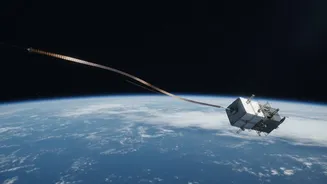
Magnetic capture is not a silver bullet, but it’s a major step forward. There are still challenges, such as developing systems powerful enough to manipulate very large objects like rocket upper stages. Some related technologies, known as electrodynamic tethers, use long, conductive wires to interact with Earth's magnetic field, generating a drag force to deorbit debris without needing propellant. Companies like Astroscale, in partnership with space agencies, are continuing to refine these technologies, with missions planned to remove actual pieces of large debris within the decade. These innovations represent a critical shift in thinking—from simply launching things into space to responsibly managing the entire lifecycle of space-based assets, ensuring that orbit remains a usable resource for generations to come.