


The Ultimate Slow-Down
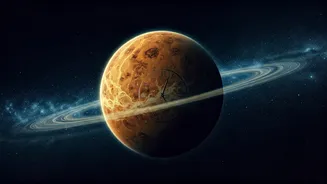
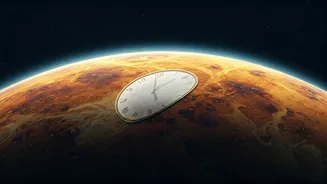
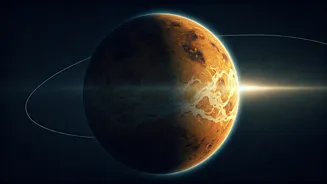
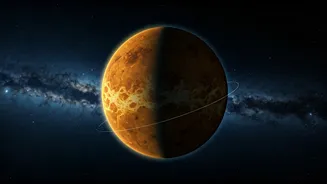
To understand this seeming paradox, we first need to define our terms. A ‘year’ is the time it takes for a planet to complete one full orbit around the Sun. For Venus, this journey takes about 225 Earth days. A ‘day’ is the time it takes for a planet to complete one full rotation
on its axis. And here is where Venus gets strange. It spins incredibly slowly, taking approximately 243 Earth days to complete just one rotation. So, there you have it: a rotation (day) of 243 days is longer than an orbit (year) of 225 days. If you were standing on Venus, the planet would complete its annual trip around the Sun before the ground beneath your feet had even finished a single spin. It’s a concept that messes with our Earth-based intuition, where our 24-hour day fits neatly into our 365-day year about 365 times.
But What Is a 'Day,' Really?
Here’s where it gets even more interesting. The 243-day figure is for a ‘sidereal day’—the time it takes to rotate once relative to the distant stars. However, what we experience as a day on Earth is a ‘solar day’—the time from one noon to the next. Because Venus orbits the Sun while it slowly spins backwards (more on that later), its solar day is different. The combination of its slow rotation and its orbital motion means that the Sun takes about 117 Earth days to return to the same point in the Venusian sky. While 117 days is still an absurdly long time to wait for lunch, it’s shorter than a Venusian year. So, while the headline is true based on the planet's physical rotation (a sidereal day), a ‘day’ in the sunrise-to-sunrise sense is actually shorter than a year. It’s a perfect example of how specific scientific definitions are crucial.
Spinning the Wrong Way
Adding to its list of quirks, Venus has a retrograde rotation. This means it spins on its axis in the opposite direction to most other planets in our solar system, including Earth. If you could stand on the surface of Venus, you would see the Sun rise in the west and set in the east. Scientists are not entirely sure why Venus spins backwards. One leading theory suggests that it was struck by a massive asteroid or other celestial body billions of years ago, which sent it spinning in the opposite direction. Another theory posits that the gravitational pull of its thick, heavy atmosphere, combined with solar tides, could have slowed its rotation to a halt and then reversed it over aeons. Whatever the cause, this backward spin is a key ingredient in its bizarre timekeeping.
Earth's Hellish Twin
The long days are just the beginning of what makes Venus one of the most hostile environments imaginable. Often called Earth’s “twin” due to its similar size and mass, the name is deeply misleading. Venus is a cautionary tale of a runaway greenhouse effect. Its atmosphere is about 96% carbon dioxide—so thick that the surface pressure is over 90 times that of Earth, equivalent to being nearly a kilometre deep in our ocean. This dense blanket of CO2 traps heat, pushing surface temperatures to an average of 465°C, hot enough to melt lead. To top it off, the planet is shrouded in permanent clouds made not of water, but of corrosive sulfuric acid. Any spacecraft that has landed there has survived for only a couple of hours before being crushed and cooked.
Why We Study Our Twisted Sister
Despite its hellish conditions, or perhaps because of them, Venus remains a huge point of interest for scientists. Studying Venus helps us understand how planets evolve. Why did Earth become a cradle for life while its twin became a furnace? By understanding the runaway greenhouse effect on Venus, we can create better models for Earth’s own climate and the potential consequences of atmospheric changes. Furthermore, as we search for habitable planets around other stars, Venus provides a crucial data point on how a planet can go so wrong. It reminds us that being in the ‘habitable zone’ is no guarantee of a friendly environment. Probing its secrets helps us understand our own planet’s past and future, and our place in the cosmic lottery.