


More Than Just a Name
The Hunter's Moon is the full moon that follows the Harvest Moon. Its name is rooted in tradition, tracing back to Native American and European folklore. Historically, this full moon provided ample light for hunters to track game in fields cleared by
the recent harvest, allowing them to stock provisions for the coming winter. This practical purpose gave the moon its name and its cultural significance as a symbol of preparation and transition. While many of us no longer hunt by moonlight, the name serves as a reminder of our long-standing connection to celestial cycles and the changing seasons.
The Orbital Dance Explained
To understand the Hunter's Moon, we first need to look at the Moon's orbit. It's not a perfect circle; it's an elliptical path, meaning its distance from Earth varies. When the Moon is at its closest point (perigee), it can appear larger and brighter, an event often called a 'supermoon'. When it's at its farthest point (apogee), it looks slightly smaller. Furthermore, the Moon's orbit is tilted by about 5.1 degrees relative to Earth's own path around the Sun, which is known as the ecliptic plane. This slight tilt is crucial. It means that from our perspective, the Moon's path across the sky changes throughout the year, sometimes rising higher and sometimes staying low.
A Shallow Angle and a Grand Illusion
The defining characteristic of the Hunter's Moon (and the Harvest Moon before it) isn't that it's physically different, but that its orbital path creates a specific effect in the autumn sky. Around the time of the autumnal equinox, the angle of the ecliptic plane to our horizon is at its shallowest in the evening. Because the Moon's orbit stays close to this plane, it appears to rise at a much shallower angle. The result is that for several nights in a row, the moonrise happens only about 30 minutes later each day, as opposed to the usual 50-minute delay. This gives the impression of a string of bright, full-moon evenings, extending the twilight and providing that legendary extra light.
Decoding the Amber Glow
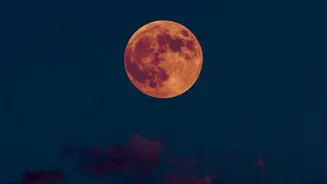
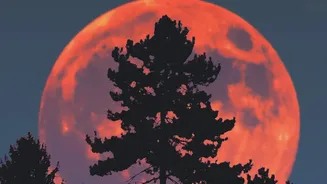
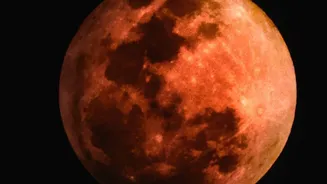
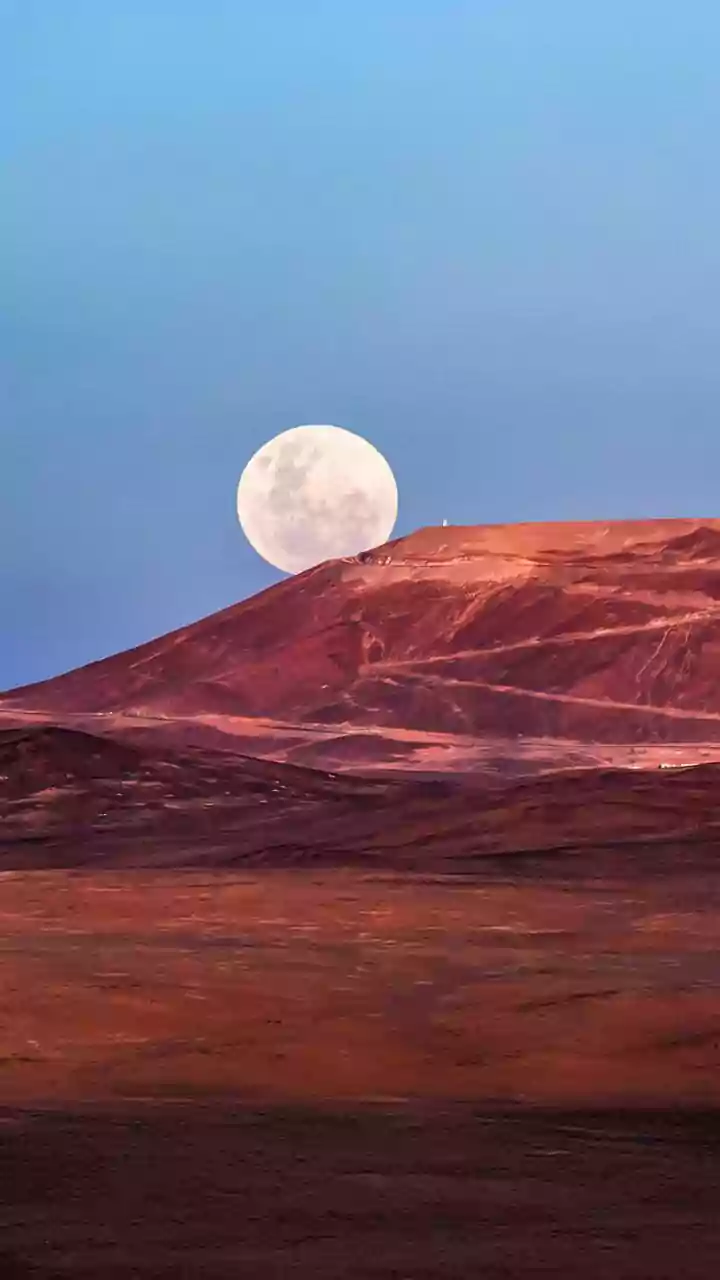
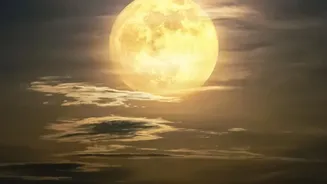
Many people associate the Hunter's Moon with a spectacular, oversized orange glow as it climbs above the horizon. The colour is very real, but the Moon itself isn't changing. When the Moon is low in the sky, its light has to travel through more of Earth's atmosphere to reach our eyes. The atmosphere scatters shorter, bluer wavelengths of light, allowing the longer, redder wavelengths to pass through more easily. This same effect, known as Rayleigh scattering, is what makes sunsets appear red. The apparent large size, however, is a fascinating trick of the mind called the 'Moon Illusion'. Our brains perceive objects on the horizon as being farther away than objects overhead. When the seemingly distant Moon is juxtaposed with familiar foreground objects like trees and buildings, our brain inflates its size.
Your Guide to Moon-Gazing
You don't need any special equipment to enjoy the Hunter's Moon on October 26. For the most dramatic view, find a location with a clear, unobstructed view of the eastern horizon. Plan to start watching around sunset on the evening of October 25 or 26. Watching the Moon as it first appears is when you're most likely to witness the deep orange colour and the impressive 'Moon Illusion'. As it climbs higher into the sky, it will transition to its more familiar silvery-white, but the science behind its initial appearance makes the moment of moonrise a truly special sight to behold.