

The Sound of Spacetime Shaking
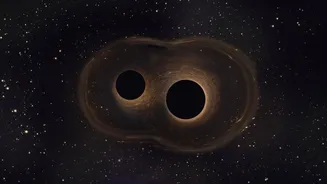
Imagine the universe as a perfectly still pond. When two incredibly massive objects, like black holes, spiral into each other and merge, they create ripples in the very fabric of space and time. These ripples, called gravitational waves, travel outwards
at the speed of light. Predicted by Albert Einstein over a century ago, their direct detection in 2015 opened a brand new way to observe the universe. Instead of seeing light, we can now 'hear' the vibrations from the most violent and energetic events in cosmic history. Observatories like the Laser Interferometer Gravitational-Wave Observatory (LIGO) in the U.S., Virgo in Italy, and KAGRA in Japan act as giant ears, listening for these faint cosmic tremors.
The Universe's Missing Link
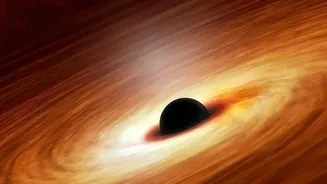
Astronomers have long known about two main types of black holes. There are 'stellar-mass' black holes, which are about 5 to 100 times the mass of our Sun, formed from the explosive death of a single massive star. Then there are the 'supermassive' black holes, behemoths that are millions or even billions of times our Sun's mass, found at the heart of most large galaxies, including our own Milky Way. But for decades, there has been a glaring gap in between: the 'intermediate-mass' black hole (IMBH), with a mass of 100 to 100,000 suns. Finding them has been a primary goal for astrophysicists, as they are believed to be the crucial 'missing link'—the seeds that grow into the supermassive giants that shape entire galaxies.
A Collision of Cosmic Middleweights
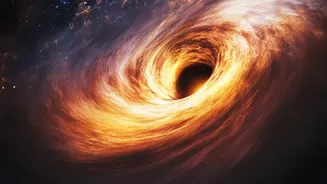
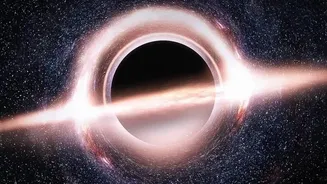
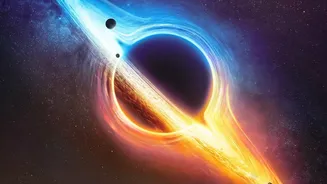
The latest breakthrough comes from detecting the gravitational waves produced by the merger of two of these elusive IMBHs. The signal, captured by the global network of observatories, signifies the violent collision of two objects far too big to be single stars but not yet large enough to be supermassive. One such landmark event, dubbed GW190521, involved two black holes of about 85 and 66 solar masses merging to create a new black hole of 142 solar masses. More recent detections, such as one announced in mid-2025, confirmed a merger creating a final black hole of 225 solar masses, pushing the boundaries of what was thought possible. These detections provide the first definitive proof that IMBHs not only exist but that they can merge.
How Giants Are Born
This discovery provides powerful evidence for a theory known as 'hierarchical merging'. The idea is that small, stellar-mass black holes merge to form slightly larger ones. These then merge again, and again, climbing the mass ladder over billions of years. Capturing the merger of two intermediate-mass objects is like finding a teenager in the black hole family album—it shows how the 'children' (stellar-mass) grow up to become the 'adults' (supermassive). This process is thought to happen most often in dense environments like globular clusters or the crowded centers of young galaxies, where black holes have a greater chance of finding each other and colliding. This finding moves the theory of how supermassive black holes form from computer simulations into the realm of observational fact.
A New Window on the Universe
With each new gravitational wave detection, the catalogue of cosmic events grows, allowing scientists to refine their understanding of the universe. The growing number of observed mergers—now totalling over 390—is helping to build a census of black holes, revealing hidden populations and providing clues about their origins. These observations don't just confirm the existence of IMBHs; they test the limits of Einstein's theory of general relativity and help us measure the expansion rate of the universe itself. The incredible precision of modern detectors can now pinpoint where in the sky these events happen, allowing other telescopes to search for any light associated with the collision. Each ripple from these ancient, violent dances brings us closer to a complete picture of how our universe evolved from the Big Bang to the star-filled cosmos we see today.