


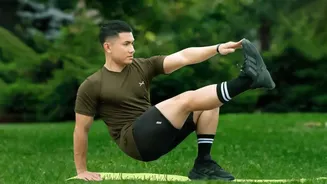
The Essential Five-Minute Warm-Up
Before you begin, preparing your body is crucial to prevent injury and maximize your workout. A proper warm-up increases blood flow to your muscles and gets your joints ready for movement. Start with 30 seconds of marching on the spot to gently raise
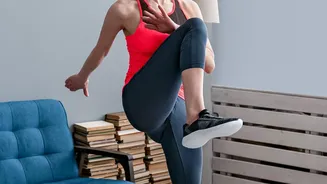
your heart rate. Follow this with dynamic stretches. Perform 10 arm circles forward and 10 backward to loosen up your shoulders. Then, do 10 leg swings on each side, holding onto a wall for balance if needed. Finish with some torso twists, rotating your upper body from side to side for 20-30 seconds to mobilize your spine. This simple routine prepares your body for the work ahead.
Upper Body Strength: Push-Ups and Dips
For your upper body and core, the push-up is a foundational exercise that targets the chest, shoulders, and triceps. If a standard push-up is too challenging, start with incline push-ups against a wall or a sturdy piece of furniture. You can also perform them on your knees. Aim for 3 sets of as many repetitions as you can manage with good form. To target your triceps, use a stable chair, sofa, or even the floor for tricep dips. Sit on the edge of the chair with your hands gripping the edge, slide your hips forward, and lower your body until your elbows are at a 90-degree angle, then push back up. This combination effectively builds upper body strength using only your body weight.
Lower Body Power: Squats and Lunges
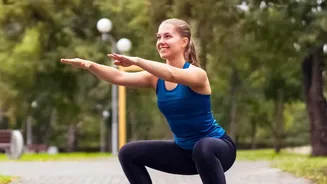
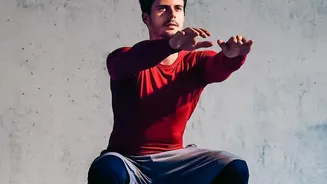
Bodyweight squats are a fantastic exercise for strengthening your quads, hamstrings, and glutes, mimicking functional daily movements. Stand with your feet shoulder-width apart and lower your hips as if sitting in a chair, keeping your chest up and back straight. For an added challenge, progress to single-leg variations. Lunges are another excellent choice for targeting each leg individually, which helps improve balance and correct strength imbalances. You can perform forward or reverse lunges on the spot. Step one foot forward or backward and lower both knees to a 90-degree angle, ensuring your front knee doesn't go past your toes. Perform 3 sets of 10-15 reps for each exercise.
Cardio and Core: Planks and Burpees
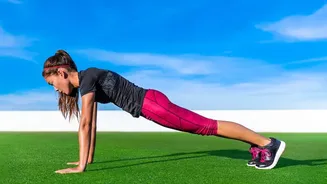
To get your heart rate up and engage your core, planks and burpees are highly effective. The plank is a premier core stability exercise that strengthens your entire midsection, which is vital for posture and injury prevention. Hold the position for 30-60 seconds, keeping your body in a straight line from head to heels. For a cardio blast, the burpee is an all-in-one move that combines a squat, plank, and push-up. A quieter, neighbour-friendly version involves walking your feet back into the plank position instead of jumping. These exercises provide both cardiovascular benefits and significant core strengthening without needing much space.
Structuring Your Workout
To create a complete workout, structure these exercises in a circuit. Perform each exercise for 45 seconds, followed by 15 seconds of rest before moving to the next. Once you complete all the exercises, rest for one to two minutes and then repeat the entire circuit 2-3 times. This circuit training format keeps your heart rate elevated, helping to build endurance and burn calories efficiently. The key to seeing results with bodyweight training is progressive overload—consistently challenging your muscles by increasing reps, adding sets, or performing more difficult variations over time.
The Crucial Cool-Down
Just as important as the warm-up, a cool-down helps your body gradually return to its resting state, which can prevent dizziness and reduce muscle soreness. Spend at least five minutes performing static stretches, holding each for 20-30 seconds. Focus on the major muscle groups you just worked. A quad stretch, a hamstring stretch (touching your toes), and a chest stretch (clasping your hands behind your back) are great options to finish your session. This promotes flexibility and aids in recovery.