



A Glimpse into the Cosmic Dawn
In a remarkable finding, an international team of astronomers has identified the most distant and compact pair of quasars ever observed. Officially designated J1602+4228AB, the pair has been given the Hawaiian nickname Nāpōwawāʻenakaulua. These two beacons
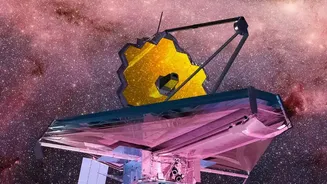
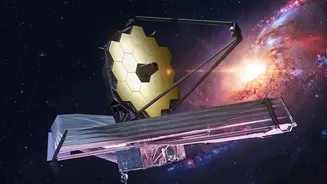
of ancient light are seen as they were when the universe was only about 900 million years old, a period known as the 'cosmic dawn' when the first stars and galaxies were forming. The discovery was made using data from the JWST's Aether survey, which aims to create a census of objects in the early universe, and was later confirmed with follow-up observations from the Gemini North telescope in Hawai'i.
What Exactly Are Quasars?
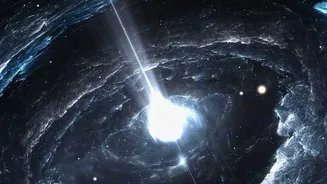
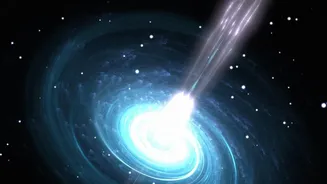
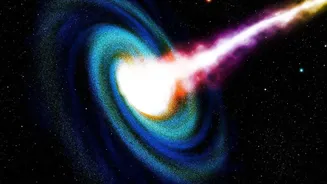
Before diving into why this pair is so special, let's clarify what a quasar is. Imagine a supermassive black hole at the center of a young galaxy. Now, imagine that black hole is having a feast, pulling in huge amounts of gas and dust. As this material spirals into the black hole, it forms a superheated, glowing disk called an accretion disk. The gravitational and frictional forces are so intense that this disk shines with unimaginable brightness, often outshining all the stars in its host galaxy combined. This incredibly luminous object is a quasar, short for 'quasi-stellar radio source'. They are some of the brightest and most distant objects we can detect.
Why Finding a Pair Is a Big Deal
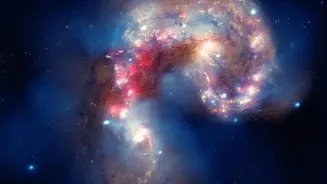
Astronomers theorize that galaxy mergers were common in the early universe, and that these collisions should create pairs of quasars. However, finding them is exceptionally rare. The Nāpōwawāʻenakaulua pair is only the third such duo found at cosmic dawn. What makes this discovery particularly mind-boggling is not just their age, but their proximity and sheer size. The two quasars are separated by only 18,100 light-years—a distance that would comfortably fit within our own Milky Way galaxy. For context, this is the most compact quasar pair ever found from this early era. Their existence provides a rare, direct snapshot of two galaxies in the process of merging, an event that is fundamental to understanding how large galaxies like our own came to be.
Rewriting the Story of Cosmic Growth
This discovery poses a significant puzzle for current models of cosmic evolution. The two supermassive black holes powering these quasars are enormous for their time, weighing in at 1.5 billion and 400 million times the mass of our Sun, respectively. According to prevailing theories, it should take more than 900 million years for black holes to grow this massive through standard processes of accretion and mergers. Finding one such giant is puzzling enough; finding two in a close embrace so early in the universe's history challenges everything. As one research team noted, there is no definitive theoretical explanation for how even a single one of these giants could exist so early, let alone two of them together. This suggests that the processes of galaxy and black hole growth in the early universe might have been far more rapid and chaotic than previously thought, likely occurring in exceptionally dense regions of matter.