





Meet the Odd Couple
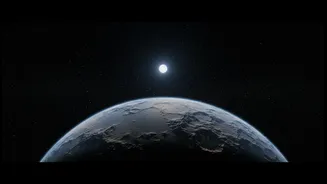
In one corner, we have WD 1856+534, the corpse of a star much like our sun. After burning through its fuel over billions of years, it puffed up into a red giant and then collapsed into a white dwarf — a super-dense, Earth-sized remnant that is slowly
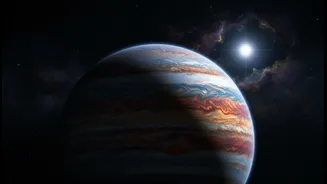
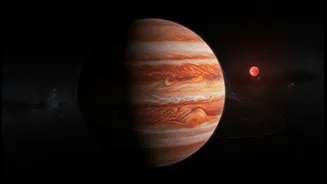
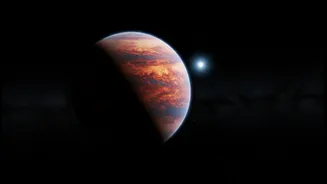
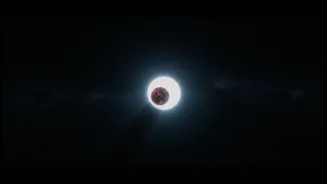
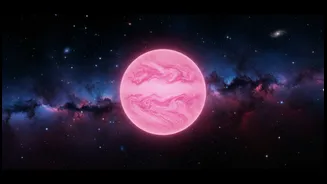
cooling down. In the other corner is WD 1856 b, a behemoth planet roughly the size of Jupiter. The truly bizarre part? This giant planet is whipping around its tiny, dead star every 34 hours, at a distance 50 times closer than Earth is to the sun. To put that in perspective, it’s like a lorry circling a football at a distance of just a few metres. The scale is all wrong, and its very existence is a fantastic puzzle.
A Cosmic Crime Scene
According to everything we know about how stars evolve, this planet should not exist. When its star swelled into a red giant, it would have expanded hundreds of times its original size, engulfing and completely incinerating anything in a close orbit. Any planet in WD 1856 b's current position would have been vaporised. So, how did this survivor end up in what scientists call the 'forbidden zone' — a place it couldn't possibly have formed or lived through its star's death throes? It's a mystery that baffled astronomers when the planet was first discovered in 2020 by NASA's TESS and Spitzer space telescopes.
The Great Migration Theory
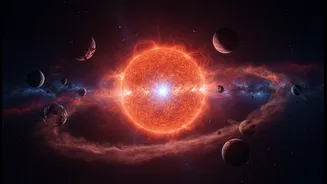
The leading theory is a story of cosmic chaos and a great escape. Scientists believe WD 1856 b must have formed much, much farther away from its star, in a safe, wide orbit similar to Jupiter's in our own solar system. It would have stayed there peacefully for billions of years, surviving the star’s violent red giant phase from a distance. Then, something gave it a massive gravitational kick. The WD 1856 system is actually a triple-star system, and the gravitational pull from the two other distant stars may have destabilised WD 1856 b's orbit. This nudge sent the planet careening inwards on a new, highly elliptical path. Over time, the intense gravity of the white dwarf would have wrestled the planet into the tight, circular orbit we see today — a process that would have dramatically heated the planet.
Clues from a Telltale Glow
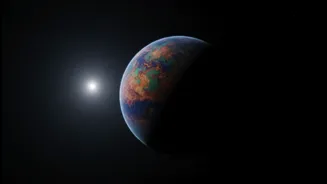
Recent observations from the James Webb Space Telescope have added a crucial piece to this puzzle. Webb analysed the planet's atmosphere and found it was significantly warmer than it should be, given the faint light from the cool white dwarf. This leftover heat is the smoking gun. By modelling how the planet would cool over time, scientists calculated that the heating event likely happened billions of years after the star had already become a white dwarf. This timeline strongly supports the migration theory over the idea that the planet somehow survived being swallowed by the red giant. Webb also detected the first-ever signs of an atmosphere on a planet orbiting a dead star, finding hints of methane and haze.
A Glimpse into Our Own Future
Beyond being a fascinating cosmic weirdo, the story of WD 1856 b provides a window into the possible future of our own solar system. In about five billion years, our sun will also become a red giant and then a white dwarf. While Mercury, Venus, and possibly Earth will be destroyed, the fate of gas giants like Jupiter and Saturn is less certain. The survival of WD 1856 b shows that planets can outlive their stars and end up in entirely new and bizarre configurations. It suggests that even after a star dies, its planetary system can have a vibrant and dynamic second act. This discovery opens up a whole new type of planetary system to study and even broadens the places where we might, one day, search for signs of life.