






The Political Backdrop
To understand the current situation, we must go back to 2019. Following the Pulwama attack, India revoked Pakistan's Most Favoured Nation (MFN) status and hiked customs duties on Pakistani imports. In response to India's August 2019 decision regarding
Article 370 in Jammu and Kashmir, Pakistan formally suspended all bilateral trade. This freeze brought official commerce to a grinding halt, closing major land routes like the Wagah-Attari border and seemingly severing economic ties that, while never reaching their full potential, were significant. The World Bank once estimated the trade potential between the two nations at a massive $37 billion, a figure that now seems more distant than ever.
Economic Necessity Overrides Politics
Despite the political standoff, economic realities have a way of carving their own path. Pakistan's industries, particularly its pharmaceutical sector, have long relied on Indian suppliers for essential raw materials known as Active Pharmaceutical Ingredients (APIs). These inputs are often more affordable and readily available from India due to geographical proximity and a competitive Indian manufacturing base. A report from the Institute of Chartered Accountants of Pakistan estimated that the country's pharma industry has a 50-60% import reliance on India. Recognizing this critical dependency, Pakistan created an exemption for medicines and their raw materials from the trade ban, allowing these vital imports to continue.
The Dubai Detour
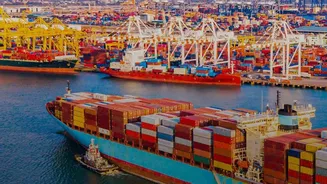
For goods not covered by the official exemption, trade has found a detour. A significant volume of Indian products now reaches Pakistan via third countries, with the United Arab Emirates (UAE) serving as a primary hub. This roundabout route involves Indian exporters sending goods to a port like Dubai, where they are often stored in bonded warehouses. Subsequently, the labels and documentation can be modified to show a new country of origin before the goods are re-exported to Pakistan. This informal or 'circular' trade, while technically bypassing direct trade restrictions, adds significant costs and complexity. One think tank estimates that as much as $10 billion worth of Indian goods may reach Pakistan annually through such channels.
What's in the Shopping Cart?
Recent data from the State Bank of Pakistan highlights this ongoing commercial relationship. In the first quarter of the 2026-27 fiscal year, Pakistan's imports from India were recorded at $61.74 million, a 69% increase from the same period the previous year. The vast majority of these imports are in the medical field. In the 2025-2026 fiscal year, organic chemicals and pharmaceutical products accounted for over 96% of Pakistan's imports from India. This included a significant rise in imports of vaccines for human use. Beyond pharma, other goods that were historically sourced from India include cotton, sugar, fertilisers, and cement, with businesses now facing higher costs to procure them from more distant markets like Brazil and the United States.
The Cost of the Freeze
The suspension of direct trade has come at a considerable economic price, particularly for Pakistan. The Chairman of the Pak-India Business Council, Noor Muhammad Qasuri, estimated that the suspension has resulted in economic losses of around $40 billion for Pakistan since 2019. Businesses face higher sourcing and logistics costs, forcing them to import goods from farther away. For example, the textile sector has reportedly incurred an extra $5 billion in costs by having to source cotton from markets other than India. This has led to growing calls from business communities on both sides to separate trade from politics and restore formal commercial ties, which could lower costs and improve supply chains for critical industries.