



A Whiff of a Water World
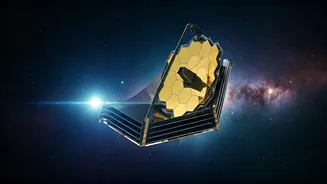
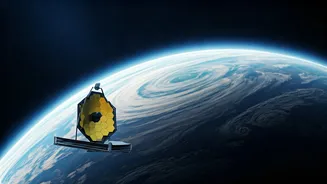
The headline-making discovery centres on an exoplanet named K2-18 b, located about 124 light-years from Earth. Using its powerful instruments, the James Webb Space Telescope (JWST) analysed the starlight filtering through the planet's atmosphere. The data
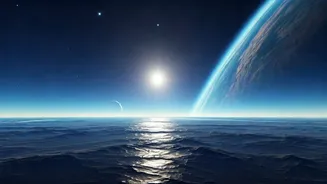
revealed an abundance of methane and carbon dioxide, along with a notable shortage of ammonia. This specific chemical cocktail is significant because it strongly supports the theory that K2-18 b could be a 'Hycean' world—a hot, ocean-covered planet with a hydrogen-rich atmosphere. The absence of ammonia is a key piece of the puzzle, as it suggests interactions with a liquid water ocean that would not occur on a purely gaseous planet.
The Tantalising 'Biosignature'
What truly set the scientific community abuzz was the possible detection of another molecule: dimethyl sulfide (DMS). On Earth, DMS is a substance overwhelmingly produced by life, primarily marine phytoplankton. Its presence in an exoplanet's atmosphere is considered a potential 'biosignature'—a chemical fingerprint hinting at biological processes. The initial detection was tantalising but not definitive, hovering at a statistical confidence level that called for caution. While an unknown, non-biological chemical process could be responsible for the DMS, its potential presence marks one of the most exciting leads in the search for life beyond our solar system.
How Webb Reads an Alien Sky
Detecting these molecules from over a quadrillion kilometres away is a monumental feat of engineering. JWST uses a technique called transmission spectroscopy. As K2-18 b passes in front of its host star, a tiny fraction of the starlight shines through the planet’s atmosphere. Different gases absorb light at specific wavelengths, leaving a unique barcode-like pattern in the spectrum of the starlight. By deciphering these patterns, astronomers can determine the chemical composition of an alien world's atmosphere with remarkable precision. The telescope's powerful infrared instruments are particularly well-suited for this task, allowing it to spot molecules that would be invisible to other observatories.
A World Unlike Any Other
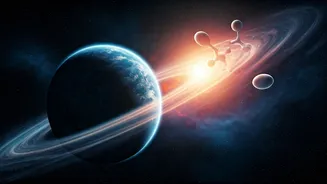
Even if confirmed, an ocean on K2-18 b would be far from an earthly paradise. The planet is a 'super-Earth,' roughly 8.6 times the mass of our planet and 2.6 times as large. It orbits a red dwarf star, which is smaller and cooler than our sun. Theoretical models of Hycean planets suggest its ocean could be extremely hot, potentially over 100 degrees Celsius, but kept in a liquid state by the immense pressure of the thick atmosphere. While this environment would be inhospitable to humans, it doesn't rule out the possibility of microbial life thriving under such extreme conditions, perhaps similar to the life found near deep-sea hydrothermal vents on Earth.
What Comes Next?
The findings for K2-18 b are a thrilling hypothesis, not a final conclusion. The detection of dimethyl sulfide, in particular, requires further validation. Scientists are planning more observation time with JWST, using different instruments to get a clearer picture and improve the statistical certainty of their findings. These follow-up studies will aim to confirm the presence of DMS and rule out any non-biological sources. Whether K2-18 b turns out to harbour life or not, the data JWST is providing has already revolutionised our ability to study these remote worlds, bringing us one step closer to answering one of humanity's oldest questions: are we alone?