






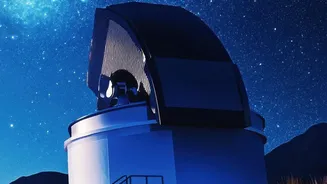

A Planetary Defense Network Takes Shape
Not long ago, the idea of defending Earth from an asteroid was pure science fiction. Today, it's a field of active science and engineering. NASA’s Planetary Defense Coordination Office (PDCO), established in 2016, spearheads a global effort to find, track,
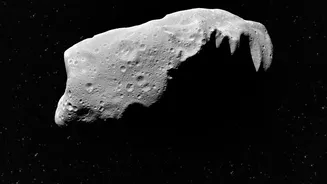
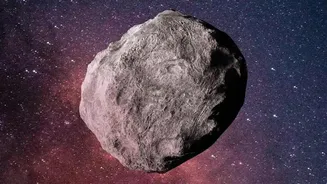
and characterize Near-Earth Objects (NEOs). This global network of telescopes and survey programs has successfully catalogued over 90% of the large asteroids — those over 1 kilometre in diameter, big enough to cause a global catastrophe. The game-changer was NASA's Double Asteroid Redirection Test (DART) mission. In September 2022, the DART spacecraft deliberately crashed into the small asteroid Dimorphos, successfully altering its orbit. This wasn't just a scientific experiment; it was a profound proof-of-concept. For the first time, humanity demonstrated it has the technology to physically move an asteroid, turning the theoretical practice of planetary defense into a tangible capability. The impact was even more effective than predicted, showcasing that a kinetic impactor is a viable tool for nudging a dangerous object off a collision course, provided we have enough warning.
The Menace of the Small and Unseen
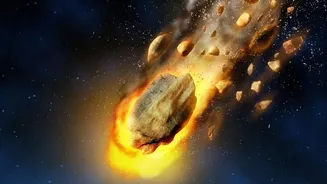
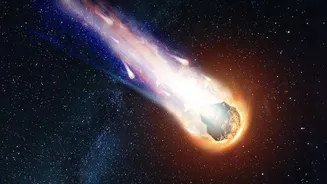
While we've gotten good at tracking the 'planet-killers', the primary challenge now lies with smaller, but still dangerous, objects. Asteroids in the range of 20 to 140 meters might not end civilization, but they can cause immense regional devastation. The 2013 Chelyabinsk event serves as a stark reminder. A relatively small, 20-meter asteroid exploded in the atmosphere over Russia with the force of about 500,000 tons of TNT, injuring over 1,500 people and damaging thousands of buildings. What made Chelyabinsk so alarming was that it was completely undetected. It approached from the direction of the sun, a notorious blind spot for ground-based telescopes. There are likely millions of these city-killer-sized objects in our solar system, and we've only found a fraction of them. They are often dark, making them difficult to see against the black of space, and their sheer number makes finding them a cosmic needle-in-a-haystack problem. Just this month, a tiny one-meter asteroid, 2026 RW1, was detected only seven hours before it harmlessly entered the atmosphere, underscoring how little warning we get for these small impactors.
New Eyes on the Sky
Fortunately, a new wave of technology is set to revolutionize our detection capabilities. The Vera C. Rubin Observatory in Chile, expected to begin its decade-long Legacy Survey of Space and Time (LSST), is at the forefront. Even in its preliminary testing phases, Rubin has shown its incredible potential, discovering thousands of new asteroids at an unprecedented rate. Its massive mirror and powerful camera will scan the entire southern sky every few nights, creating the most detailed census of our solar system ever. Projections show Rubin could discover millions of new asteroids. However, even Rubin has its limitations. One study showed that while it will be excellent at finding large impactors, it might only spot about 27% of objects in the 20-50 meter range, often with only weeks of warning. To help cover the blind spots, NASA is developing the NEO Surveyor, an infrared space telescope scheduled to launch around 2027. By detecting the heat signature of asteroids, NEO Surveyor will be able to find dark objects and those hiding in the sun's glare, areas where optical telescopes struggle.
From Detection to Deflection
Finding an asteroid is only the first step; the ultimate goal is to have a plan. The success of the DART mission provides a foundational strategy: kinetic impact. But the effectiveness of this method depends on the asteroid's composition—whether it's a solid block of rock or a loose 'rubble pile'. The upcoming Hera mission from the European Space Agency will visit Dimorphos to study the aftermath of DART's impact, providing crucial data that will help refine our deflection models. The key to any successful defense strategy is time. The earlier we detect a threat, the less force is needed to nudge it onto a safe path. This is why the hunt for smaller asteroids is so critical. An object found decades before a potential impact can be deflected with current technology. An object found only months or weeks away presents a much more complex and dangerous problem. The international coordination through groups like the International Asteroid Warning Network (IAWN) ensures that once a credible threat is identified, the information is shared globally so that action can be planned and civil defense agencies can prepare.