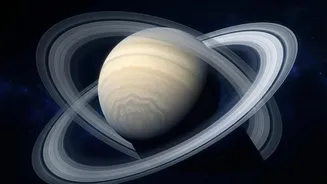







Saturn's Famous Hexagon
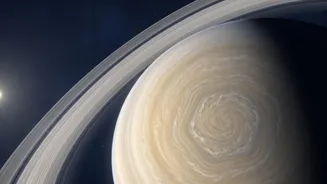
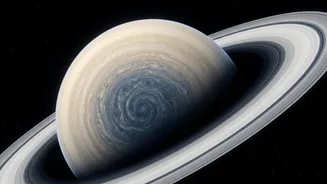
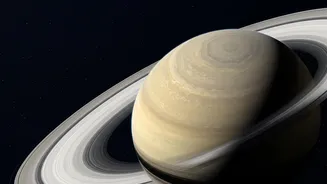
First spotted by the Voyager missions in the 1980s, Saturn’s northern hexagon is one of the most mysterious weather patterns in our solar system. It's a massive jet stream, a current of air whipping around the pole at over 320 kilometres per hour, locked
into a near-perfect six-sided shape. Each side of the hexagon is longer than the diameter of Earth, making it a structure of unimaginable scale. Unlike hurricanes on Earth that last for weeks, this colossal storm has been stable for at least 40 years, and possibly for centuries. For a long time, it was considered a one-of-a-kind cosmic anomaly.
A New Polygon Appears
The latest headline-making news is that the hexagon is no longer unique. Recent images from the Hubble Space Telescope have confirmed the existence of a second polygonal storm, this time at Saturn's south pole. This new feature is a decagon—a 10-sided pattern—that is even larger than its northern counterpart. The discovery came as a surprise. After the Cassini spacecraft ended its mission in 2017, there was no dedicated probe at Saturn, and the planet's south pole was tilted away from Earth's view until 2023. When astronomers, including sharp-eyed amateurs, finally got a good look, they noticed the emerging 10-sided wave.
Why Do These Shapes Form?
Planetary storms are almost always circular or oval, shaped by the planet's rotation. So how does a gas giant create straight lines and sharp corners? The leading theory involves the physics of its jet streams. Scientists believe that when you have a steep difference in wind speeds at a certain latitude, the atmospheric flow can meander into a stable, geometric wave pattern. Laboratory experiments on Earth have replicated this effect by spinning a tank of liquid at different speeds at its center and edge, producing three- to eight-sided shapes. The exact conditions of wind, pressure, and temperature must be just right, which may explain why these features are so rare. The discovery of a second polygon suggests these conditions might not be as unique to the north pole as once thought.
An Evolving Mystery
Unlike the seemingly permanent hexagon, the southern decagon appears to be a new and evolving phenomenon. By analysing Hubble images going back to 2023, researchers saw it was faintly present before becoming more defined in 2024 and 2025. This gives scientists a rare, front-row seat to watch how one of these giant atmospheric patterns develops in real time. They will be watching closely as Saturn's southern hemisphere heads into its summer, bathing the new storm in more sunlight. This could cause changes in the decagon, providing crucial clues about how it formed and whether it will last as long as the northern hexagon.
What This Means for Science
The existence of two different polygons on the same planet changes everything. It suggests that such geometric storms are a more fundamental behaviour of gas giants than previously understood. The decagon is not a perfect mirror of the hexagon; it's at a different latitude and appears less robust, at least for now. Studying how and why these two poles produce different shapes will become a major focus for planetary scientists. With the powerful James Webb Space Telescope also turning its infrared eyes on the planet, we are poised to learn more about these deep, towering atmospheric structures and the hidden physics that govern them.