





How Webb 'Sees' Water
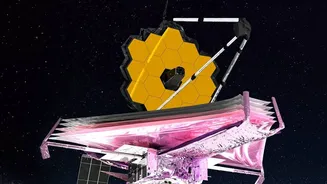
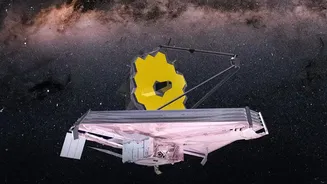
The JWST doesn't look for alien oceans directly. Instead, it uses a clever technique called transmission spectroscopy. When an exoplanet passes in front of its host star from our point of view, a tiny fraction of the starlight filters through the planet's
atmosphere. Different molecules in that atmosphere absorb light at very specific wavelengths, or colours. Water, methane, and carbon dioxide each leave a unique chemical fingerprint on the light that reaches the telescope. By capturing this light and splitting it into a spectrum, scientists can identify the molecules present and learn about the composition of a world hundreds of light-years away. Webb's powerful infrared instruments are particularly sensitive to these molecular signatures, allowing for the most detailed analysis of exoplanet atmospheres to date.
A Glimpse of a Watery World
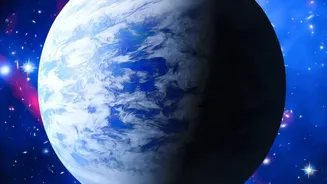
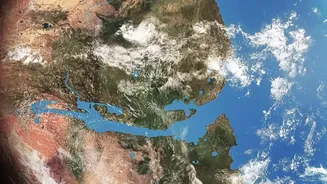
Recent findings have highlighted just how powerful this technique is. One of the most talked-about targets is K2-18 b, an exoplanet 124 light-years away that is about 8.6 times the mass of Earth. Observations with the JWST have confirmed the presence of carbon-bearing molecules like methane and carbon dioxide in its atmosphere. This discovery supports the theory that K2-18 b could be a 'Hycean' world—a planet with a hydrogen-rich atmosphere and a surface potentially covered by a water ocean. While Hubble first hinted at water vapour there, Webb's more detailed analysis has provided a clearer picture. This doesn't confirm an ocean, but it makes K2-18 b one of the most compelling targets in the search for habitable environments.
Not Always a Simple Signal
Detecting water is exciting, but it's not always straightforward. Scientists studying the rocky exoplanet GJ 486 b, just 26 light-years away, found a tantalising signal that was almost certainly due to water. However, they faced a puzzle: was the water in the planet's atmosphere, or was it coming from cool spots on the surface of the planet's host star? Red dwarf stars, which are cooler than our Sun, can have water vapour in their photospheres, which could mimic the signal of a planetary atmosphere. This ambiguity shows the complexity of the science. Researchers plan to use other instruments on Webb to look at the planet's day side. If it has an atmosphere, heat will be circulated, changing the temperature profile in a way the telescope can detect.
The Blueprint for Rocky Planets
Webb isn't just looking at fully formed planets; it's also studying the nurseries where they are born. In a system called PDS 70, located 370 light-years away, the telescope detected water vapour in the inner disk of gas and dust where rocky, Earth-like planets are likely forming. This was the first time water has been detected in the terrestrial, planet-forming region of a disk already known to host planets. This discovery is crucial because it suggests that planets like Earth could have water available to them from the very beginning of their formation, a key ingredient for life as we know it. Previously, scientists debated whether water was delivered to Earth later by asteroids and comets or if it was present from the start. Webb's data suggests the latter is a strong possibility.