


The Planet of Perfect Storms
When we think of storms, we picture the swirling cyclones of a hurricane on Earth or Jupiter’s Great Red Spot. But on Saturn, the universe gets creative. For decades, scientists have been captivated by a bizarre and utterly unique weather pattern at the planet’s
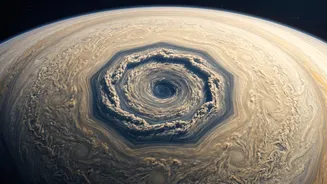
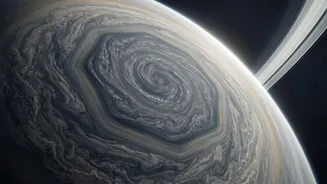
north pole: a massive, six-sided jet stream known as 'the hexagon.' First spotted by the Voyager spacecraft in the early 1980s, this feature is not a storm in the traditional sense, but a 20,000-mile-wide atmospheric river whipping around the pole at hundreds of miles per hour. Its stable, geometric shape has baffled and fascinated scientists, seeming more like a work of science fiction than atmospheric science. It has persisted for decades, perhaps centuries, a towering monument of churning gas as wide as two Earths.
A New Mystery in the South
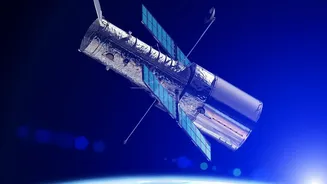
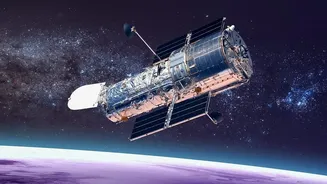
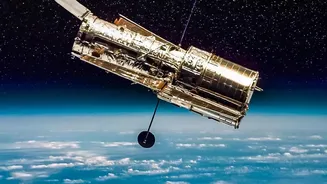
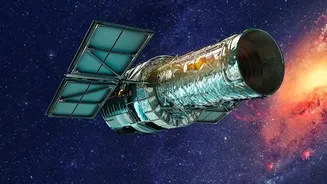
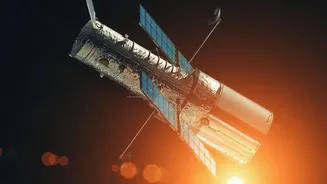
For years, the southern pole of Saturn appeared to be the hexagon’s less interesting sibling. As the Cassini spacecraft observed it during the southern summer, it saw a massive, hurricane-like vortex but no clean, geometric shape. That part of the planet was then plunged into a long, dark winter, hidden from our best telescopes. Now, as spring arrives in Saturn's southern hemisphere, light is once again falling on the pole, and recent observations suggest something incredible is forming. A 2023 study, combining data from amateur astronomers with the sharp eye of the Hubble Space Telescope, has provided compelling evidence that a new polygon may be taking shape. While the headline's ten-sided wave points to the complexity of these emerging patterns, scientists are confirming the presence of a multi-sided structure that echoes the famous northern hexagon.
The Science of Cosmic Geometry
How can a chaotic, churning atmosphere create a shape as orderly as a polygon? The answer lies in the physics of rotating fluids. Scientists have been able to replicate these shapes in laboratory experiments using spinning buckets of water. When conditions are just right, standing waves can form in the fluid, creating stable, geometric patterns. On Saturn, the jet stream acts as a boundary. Deep within the planet's atmosphere, winds are being sheared at different speeds and latitudes. These shearing layers can create instabilities that manifest as enormous, planet-spanning waves. The six-sided shape of the northern hexagon is believed to be the most stable configuration for the specific conditions at that pole. The emergence of a similar, though not necessarily identical, shape in the south suggests these phenomena may be a fundamental feature of gas giant dynamics, not a one-off fluke.
Why These Shapes Matter
Observing these giant geometric patterns does more than just create stunning images; it provides a unique window into the hidden depths of Saturn’s atmosphere. The polygons are like visible signatures of the powerful jet streams that drive them, allowing scientists to measure wind speeds and study atmospheric waves that are otherwise invisible. They also act as barriers, trapping haze and other atmospheric particles within their boundaries, which explains why the polar regions often have a different colour than the rest of the planet. Furthermore, these discoveries help us understand planetary weather across the solar system. Jupiter, for instance, also has polar polygons, but they are arranged differently, as clusters of smaller cyclones. By comparing Saturn's massive, singular shapes with Jupiter's storm clusters, scientists can refine their models of how gas giants work from the inside out.