

The Ghost of a Star
To understand this remarkable story, we first need to meet its central character: the white dwarf. A white dwarf is the dense, collapsed core left over after a star like our Sun runs out of fuel. Having swelled into a red giant and shed its outer layers,
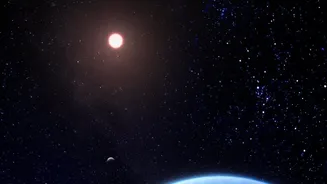
all that remains is a super-dense, Earth-sized remnant that slowly cools over billions of years. Its gravity is immense, about 100,000 times that of Earth's. Any original planets orbiting too closely would have been incinerated during the red giant phase. Those further out may survive, but their star system is forever changed. This is the environment where our story takes place, around a young white dwarf named HS 0209+0832, located about 270 light-years away.
Rising From the Ashes
So, what is a 'second-generation' planet? Most planets, including Earth, are first-generation. They formed from the primordial disc of gas and dust that surrounded their star at its birth. A second-generation planet is a world that forms much later, from material created during the star's death throes. As the star ejected its layers, some of that material could, in theory, coalesce into a new disc and eventually form new planets. For years, this was a theoretical possibility, mostly suspected to occur around exotic objects called pulsars. Finding a candidate around a much more common white dwarf was, as one researcher noted, 'completely unexpected'.
A Chemical Cold Case
The clue that points to this cosmic rebirth is a 25-year-old mystery. When NASA's Hubble Space Telescope observed the white dwarf HS 0209+0832 in 1999, it detected about 100 chemical signatures in its atmosphere that couldn't be identified. Recently, a team led by researchers from the University of Warwick revisited this archival data. Using updated chemical databases, they solved the puzzle: many of the mystery lines matched the element niobium. The atmosphere also showed unusual amounts of zinc and copper. These heavy elements are forged inside dying stars, and the amount of niobium detected—over 1,000 times more than in our Sun—was a major red flag.
An Evaporating Giant
This strange chemical cocktail doesn't match known asteroids or comets, which are usually responsible for 'polluting' white dwarf atmospheres. The most likely explanation, scientists believe, is that the white dwarf is currently feeding on a newly formed, second-generation giant planet. This proposed planet, estimated to be a gas giant similar to Jupiter, orbits the white dwarf at an incredibly close distance, completing a circuit in just 4.4 days. Because the white dwarf is still young and intensely hot, its radiation is blasting the planet and stripping away its atmosphere. This material forms a disc around the star and is slowly being accreted onto its surface, which is how Hubble was able to detect the strange elements in the first place.
The Path to Confirmation
It's crucial to remember that this second-generation planet is still a candidate, not a confirmed discovery. The evidence is indirect, based on the star's atmospheric composition and a repeating brightness variation. Direct observation of the planet has not yet been achieved. However, the clues are compelling. The strange abundance of niobium, an element created in the heart of a dying star, strongly suggests the planet formed from the star's own remains. The discovery highlights that a star's death might not be the end of its planetary story, but perhaps just the end of the first chapter. If confirmed, it would be the first planet of its kind and could reshape our understanding of how and where planets can form.