




More Than Just a Six-Pack
Before we dive into the exercises, it’s worth knowing why a strong core is so important. Your core muscles, which include your abs, hips, and lower back, are the central support system for your entire body. A strong core improves posture, reduces back pain,
and enhances balance and stability, making everyday activities easier and lowering your risk of injury. Whether you're lifting groceries, playing with your children, or engaging in sports, a stable core is the foundation of almost every movement you make. These exercises are designed to build this functional strength, not just surface-level definition.
1. The Classic Plank
The plank is a powerhouse of core conditioning. It’s an isometric exercise, meaning you build strength by holding a static position. It engages all layers of your abdominal muscles, plus your back, shoulders, and glutes. How to do it: Lie on your stomach and place your forearms on the floor with your elbows directly under your shoulders. Clasp your hands if it’s more comfortable. Lift your hips off the floor, keeping your body in a straight line from your head to your heels. Don’t let your hips sag or rise too high. Keep your neck neutral by looking at the floor just ahead of your hands. Engage your abs by imagining you are bracing for a punch. Start by holding for 20-30 seconds and gradually increase the time as you get stronger.
2. Bicycle Crunches
This dynamic movement is fantastic for targeting the main abdominal muscles (rectus abdominis) and the muscles on your sides (obliques). The twisting motion helps improve coordination and core stability. How to do it: Lie on your back with your knees bent and feet flat on the floor. Place your hands lightly behind your head without interlocking your fingers, ensuring you don't pull on your neck. Lift your head, shoulders, and feet off the floor. Bring your right knee towards your chest while simultaneously twisting your torso to bring your left elbow towards it. As you do, straighten your left leg. Then, switch sides in a controlled, fluid 'pedalling' motion. Focus on a slow, deliberate pace; speed is less important than form. Aim for 15-20 repetitions per side.
3. Lying Leg Raises
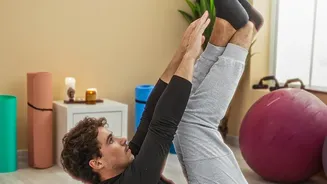
If you want to target the often-neglected lower abdominal muscles, leg raises are your go-to exercise. The key to this move is control and ensuring your lower back stays connected to the floor. How to do it: Lie on your back with your legs straight and together. You can place your hands under your hips for extra lower back support. Keeping your legs as straight as possible, slowly raise them towards the ceiling until they are perpendicular to the floor. Pause at the top, then slowly lower them back down without letting them touch the ground. Exhale as you lift, and inhale as you lower. If this is too challenging, start by bending your knees slightly. Complete 10-15 repetitions.
4. Bird-Dog Crunch
This exercise is a true test of balance and stability, working the deep core muscles that support your spine. It improves coordination while strengthening your abs and back simultaneously. How to do it: Start on all fours in a 'tabletop' position, with your hands directly under your shoulders and your knees under your hips. Engage your core to keep your back flat. Simultaneously extend your right arm straight forward and your left leg straight back. Hold for a moment, then bring your right elbow and left knee in to touch under your torso. Extend them back out and return to the starting position. Repeat on the other side, extending your left arm and right leg. That’s one repetition. Aim for 10-12 reps.
Building a Consistent Routine
Consistency is more important than intensity when you're starting out. You don't need to do these exercises every day. Aim to perform a core workout 3-4 times a week on non-consecutive days to allow your muscles time to recover and rebuild. You can combine these moves into a simple circuit. For example, perform each exercise for the recommended reps or time, rest for 30-60 seconds, and then move to the next. Once you’ve completed all the exercises, that’s one circuit. Rest for a minute or two and repeat the entire circuit 2-3 times. Listen to your body, focus on maintaining good form, and you will build a stronger, more resilient core right in your own home.