


Listening to the Universe's Echoes
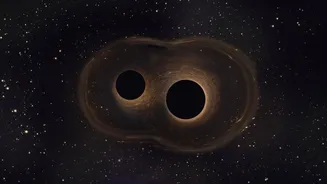
Imagine dropping a stone into a perfectly still pond. The ripples that spread out are similar to what happens when massive objects like black holes spiral into each other and merge. These cosmic collisions are so violent they create ripples in the very
fabric of spacetime. Predicted by Albert Einstein in 1916, these 'gravitational waves' were only directly detected for the first time in 2015. Today, a global network of incredibly sensitive observatories—LIGO in the United States, Virgo in Italy, and KAGRA in Japan—acts as a giant ear to the universe. By sensing these minuscule vibrations, scientists can pinpoint cataclysmic events that happened billions of light-years away and billions of years ago. Each detection, a faint 'chirp' in the data, offers a new snapshot of the universe's most extreme inhabitants and the forces that shape them.
Black Holes with a Backstory
For years, the standard story was simple: a massive star dies, its core collapses, and a black hole is born. But recent data is revealing a more complex and fascinating family tree. Scientists are finding evidence of 'hierarchical merging'—the idea that some black holes are not first-generation but are actually the result of previous black hole mergers. It’s like finding that some of the cosmic dancers are not on their first waltz. The clue lies in a black hole's spin. A black hole born from a single star's collapse should have little to no spin. However, when two black holes merge, the resulting, larger black hole is expected to spin very fast. Detections of mergers involving one fast-spinning black hole suggest it's a 'second-generation' object, born from a previous collision. This tells us that some parts of the universe are incredibly crowded, likely dense star clusters where black holes can meet and merge repeatedly.
A New Cosmic Measuring Tape
One of the biggest questions in cosmology is exactly how fast the universe is expanding—a value known as the Hubble constant. Different measurement methods have yielded conflicting results, creating a major tension in the field. Gravitational waves offer a completely new and independent way to tackle this problem through what are called 'standard sirens'. Much like a siren of a known loudness tells you how far away an ambulance is, the intrinsic strength of a gravitational wave signal from a merger reveals its distance from Earth. By combining this precise distance measurement with information about the host galaxy's speed, scientists can calculate the expansion rate without relying on the traditional 'cosmic distance ladder' of stars and supernovae. With each new detection, especially those with clear signals like the recently observed GW240615, astronomers are refining this cosmic measuring tape and hoping to resolve the long-standing debate.
Challenging the Rules of Star Life
The latest gravitational wave catalogs, which have nearly doubled the number of known black hole collisions, are also forcing scientists to rethink how black holes can even form. One recent detection, GW231123, resulted from the merger of two black holes that created a final behemoth 225 times the mass of our sun. The original black holes in this event fall into what's known as a 'mass gap'—a range where, according to standard models of stellar evolution, black holes shouldn't exist. Finding them suggests that our understanding of the lives and deaths of the most massive stars is incomplete. These forbidden mergers may be evidence of hierarchical merging in action, where smaller black holes combine to create larger ones that could not have formed from a single star. This growing library of hundreds of merger events is providing the statistical power needed to test and refine our theories of cosmic evolution.