






Meet the Cosmic Ghosts
Trillions of particles called neutrinos are passing through your body every second, yet you feel nothing. Often called 'ghost particles', neutrinos are fundamental building blocks of the universe, but they barely interact with anything. They have almost
no mass, no electric charge, and travel at nearly the speed of light, allowing them to pass through planets, stars, and entire galaxies as if they were empty space. This ghostly nature makes them incredibly difficult to detect, but it’s also what makes them perfect cosmic messengers. They are born in the heart of the most extreme events in the universe: the nuclear furnace of our Sun, the explosive death of massive stars (supernovae), and the chaotic environments around supermassive black holes. Unlike light, which can be blocked or scattered by dust and gas, neutrinos travel in a straight line from their source, carrying unaltered information across billions of light-years.
Inventing a 'Shadow Blaster'
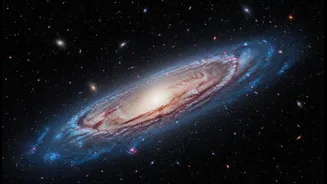
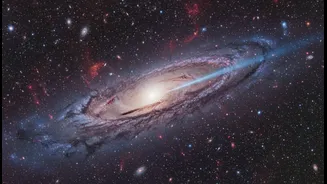
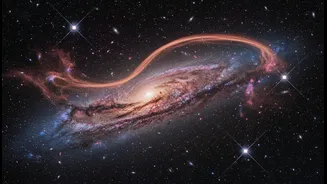
So how do you catch a ghost? While a machine called a 'Shadow Blaster' doesn't literally exist, the name perfectly captures the spirit of what real-world neutrino observatories do. Interestingly, a galaxy nicknamed 'Shadow Blaster' is being studied as a potential source of high-energy neutrinos. Scientists build enormous detectors to 'blast' the darkness and reveal these faint shadows. One of the most famous is the IceCube Neutrino Observatory in Antarctica, which uses a cubic kilometre of pristine ice as its detector. More than 5,000 light sensors are embedded deep within the ice, waiting in total darkness. On the very rare occasion a high-energy neutrino strikes an atom in the ice, it creates a tiny flash of blue light called Cherenkov radiation. By mapping this light, scientists can reconstruct the neutrino's path and energy, tracing it back to its cosmic source. Here in India, the proposed India-based Neutrino Observatory (INO) aims to build one of the world's most massive detectors to perform similar cutting-edge research.
Messages from a Violent Universe
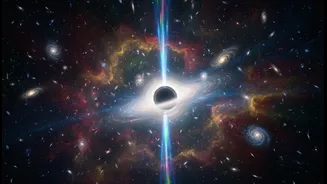
Each detected neutrino is a postcard from a cataclysm. High-energy neutrinos are fingerprints of the most violent processes in the cosmos, which are often hidden from conventional telescopes. For example, when a massive star runs out of fuel and collapses under its own gravity, it explodes as a supernova. While the visual light from this event is spectacular, 99% of the supernova's immense energy is released in the form of neutrinos. Detecting these particles gives us a direct window into the core-collapse mechanism. Similarly, astronomers have traced high-energy neutrinos back to blazars, which are giant galaxies with supermassive black holes at their centres that happen to be pointing powerful jets of particles directly at Earth. These jets are like colossal particle accelerators, and the neutrinos they create carry information about physics under conditions far more extreme than anything we can create on Earth. By studying these particles, we are not just observing distant objects; we are probing the fundamental laws of nature.
The Galactic Circle of Life
This is where the very small connects to the very large. The violent events that produce high-energy neutrinos are the primary engines of galaxy evolution. When a supernova explodes, it doesn't just fade away; it enriches the surrounding space with heavy elements like carbon, oxygen, and iron—the very materials needed to form new stars and planets. Without these stellar deaths, the building blocks of life, including those on Earth, would not exist. The immense energy released also sends shockwaves through clouds of gas, triggering new waves of star formation and sculpting the galaxy's shape. Furthermore, neutrinos themselves, while tiny, are so numerous that their collective gravity can influence how large-scale structures, like clusters of galaxies, form over billions of years. By using neutrinos to pinpoint and understand supernovae and other energetic phenomena, we are effectively watching the process of galactic evolution in action. We are seeing how galaxies are seeded with new material, how they grow, and how they change over cosmic time.