








An Audacious Leap in Exploration
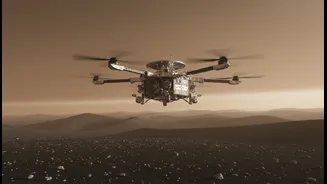
Dragonfly is not just another rover. It's a dual-quadcopter, or rotorcraft, about the size of a small car. Unlike the lightweight Ingenuity helicopter that performed technology demonstrations on Mars, Dragonfly is a full-fledged science laboratory. It's designed
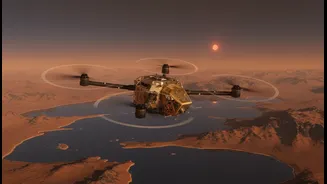
to make multiple flights across the surface of Titan, travelling dozens of kilometres in a single hop. This mobility is a game-changer, allowing scientists to sample diverse geological settings that would be unreachable for a ground-based rover. Instead of solar panels, which would be useless under Titan's thick, hazy sky, Dragonfly will be powered by a Multi-Mission Radioisotope Thermoelectric Generator (MMRTG). This device, similar to what powers the Curiosity rover on Mars, uses the heat from decaying plutonium to generate electricity, giving the mission the energy it needs to fly, operate its scientific instruments, and survive the extreme cold for a planned mission of over three years.
Destination Titan: A World of Possibilities
The choice of Titan is what makes this mission so compelling. Saturn's largest moon is one of the most intriguing bodies in our solar system. It is the only moon with a substantial atmosphere, which is four times denser than Earth's. This thick nitrogen and methane atmosphere, combined with Titan's low gravity, makes it an ideal place for flight. But it's the moon's surface and chemistry that truly fascinate scientists. Titan has a weather system based on methane, with methane rain filling rivers, lakes, and seas. Its surface is covered in organic materials that rain down from the atmosphere, creating vast fields of dunes. Scientists believe this environment is a natural laboratory for prebiotic chemistry, the complex chemical reactions that occurred on Earth before life began. Essentially, Titan may hold a frozen record of the steps that can lead to life.
Searching for Life's Building Blocks
Dragonfly is not looking for existing life but for what scientists call 'biosignatures' and evidence of 'prebiotic chemistry'. The mission's primary goal is to understand how far the process of creating life's ingredients has progressed on Titan. Energy from sunlight and particles from Saturn's magnetosphere break down methane and nitrogen in Titan's upper atmosphere, forming more complex organic molecules. These molecules, including hydrogen cyanide, rain down on the surface. Over billions of years, this has created a landscape rich with the raw materials for life. Dragonfly will land, drill into the surface to collect samples, and pull them into an onboard mass spectrometer for analysis. Scientists are particularly interested in exploring areas like the Selk impact crater, where heat from the impact may have melted water ice, creating a temporary environment where organic molecules and liquid water could have mixed — a key recipe for life as we know it.
The Long Journey Ahead
The path to Titan is a long and carefully planned one. NASA has confirmed the mission for a launch in July 2028 aboard a SpaceX Falcon Heavy rocket. Even with a powerful launch vehicle, the journey across the solar system will take about six years, with Dragonfly scheduled to arrive at Titan in 2034. Upon arrival, the spacecraft will perform a complex entry and descent through the thick atmosphere before landing in the Shangri-La dune fields near Titan's equator. From there, its exploration will begin. During its multi-year mission, Dragonfly is expected to fly from one location to another every 16 Earth days, covering a total distance of over 175 kilometres. This 'leapfrog' approach will provide an unprecedented survey of a world that could hold clues to one of humanity's most profound questions.