





India's Next Interplanetary Frontier
After conquering the Moon's south pole and sending a probe to Mars, the Indian Space Research Organisation (ISRO) is preparing for its first-ever mission to Venus. Named Shukrayaan-1, from the Sanskrit words for Venus (Shukra) and craft (Yaan), the mission represents
a bold new chapter in India's space ambitions. The government formally approved the Venus Orbiter Mission in September 2024, scheduling the launch for March 2028. The spacecraft, launched aboard a powerful LVM-3 rocket, will embark on a 112-day journey to enter an orbit around our nearest planetary neighbour. Equipped with a suite of scientific instruments, including a high-resolution radar to peer beneath the planet's thick clouds, Shukrayaan-1 aims to study Venus's surface, atmosphere, and volcanic activity in unprecedented detail. But its most profound goal is to understand why a planet so similar to our own became a desolate, hostile world.
Venus: Earth's 'Evil Twin'
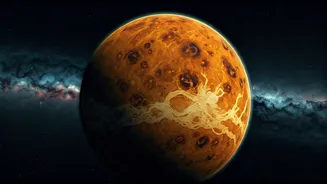
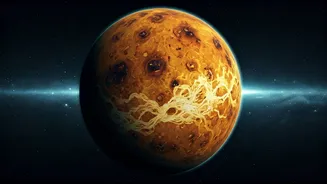
Scientists often refer to Venus as Earth's "evil twin." Both planets are similar in size, mass, and composition, and scientists believe they were formed from the same materials 4.6 billion years ago. Evidence suggests that early Venus may have even hosted liquid water oceans for as long as two billion years, potentially creating conditions suitable for life. Yet, today, Venus is a hellscape. Its atmosphere is over 90 times denser than Earth's, composed almost entirely of carbon dioxide with clouds of sulfuric acid. This toxic blanket has triggered a catastrophic, runaway greenhouse effect, trapping heat and sending surface temperatures soaring to an average of 465 degrees Celsius—hot enough to melt lead. Understanding the turning point in Venus's history—how it transformed from a potentially habitable world to a scorching wasteland—is a primary driver of modern planetary science.
A Laboratory for Climate Change
The extreme conditions on Venus provide a perfect natural laboratory for studying climate change. By examining how the runaway greenhouse effect played out on Venus, scientists can vastly improve the models used to predict climate behaviour here on Earth. The mission's objectives include analyzing the chemistry of Venus's thick atmosphere and studying how the solar wind interacts with it, which will offer clues about how the planet lost its water. While Earth is not in immediate danger of becoming a Venus-like hothouse, studying our neighbour serves as a critical cautionary tale. It demonstrates that a planet's climate stability is not guaranteed and can be dramatically altered. Shukrayaan-1's findings will help scientists better understand the tipping points in a planet's climate system, providing invaluable data as we grapple with the effects of rising carbon dioxide levels in our own atmosphere.
A Global Scientific Endeavour
India is not alone in its renewed interest in Venus. NASA has two missions planned—DAVINCI and VERITAS—and the European Space Agency is developing its EnVision orbiter. ISRO's Shukrayaan-1, however, is notable for its collaborative approach, incorporating payloads and expertise from international partners, including Sweden, France, Germany, and Russia. This global cooperation underscores a shared scientific consensus: understanding Venus is a crucial priority. The mission will not only provide a wealth of data for Indian scientists but will contribute to a global body of knowledge that could be vital for the long-term health of our own planet. By exploring Earth's twisted sister, India is taking on a scientific challenge that has profound implications for all of humanity.