



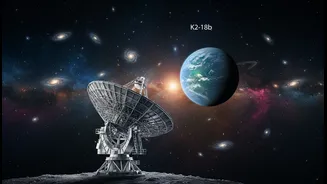


Why Is K2-18b So Special?
K2-18b is an exoplanet that's captured the imagination of scientists and the public alike. It’s about 8.6 times the mass of Earth and orbits its cool red dwarf star within the habitable zone—the region where temperatures could allow for liquid water to
exist. Initial observations from the James Webb Space Telescope (JWST) revealed an atmosphere containing methane and carbon dioxide. This chemical mix, combined with its size and location, makes K2-18b a prime candidate for a “Hycean” world—a theoretical type of planet with a global water ocean under a hydrogen-rich atmosphere. On paper, it’s one of the most compelling places to look for life beyond our solar system.
The Tantalising Hint of a Biosignature
The excitement around K2-18b skyrocketed when astronomers reported the tentative detection of dimethyl sulfide (DMS) in its atmosphere. On Earth, DMS is a gas produced almost exclusively by life, particularly marine phytoplankton. Finding it on another world could be a monumental discovery—a potential “biosignature” pointing to biological processes. However, the scientific community remains divided. The initial detection was not strong enough to be conclusive, with some studies suggesting the signal could be a statistical fluke or caused by other, non-biological molecules. The debate highlights a crucial challenge in astrobiology: extraordinary claims require extraordinary evidence, and detecting a single gas is not definitive proof of life.
Enter the Radio Telescopes
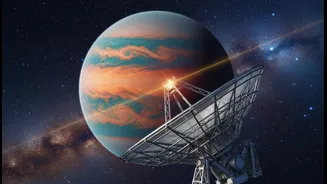
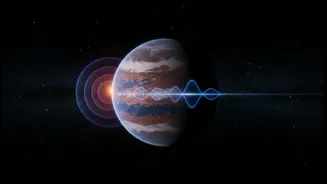
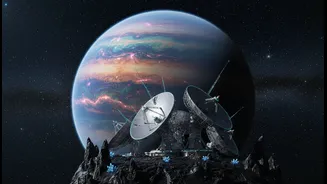
This is where the new, massive radio survey comes in. A team of researchers used two of the world's most powerful radio telescope arrays—the Very Large Array (VLA) in New Mexico and the MeerKAT in South Africa—to listen for artificial signals from K2-18b. This is the classic SETI (Search for Extraterrestrial Intelligence) approach: searching for technosignatures, such as radio transmissions, that would indicate an advanced civilization. The team sifted through millions of potential signals, using advanced software to filter out interference from Earth and other cosmic noise. They specifically looked for narrowband signals, the kind our own technology produces.
Silence, and What It Tells Us
The survey's conclusion was a resounding silence. No convincing artificial radio signals were found coming from K2-18b. While that might sound like a disappointment, the result is incredibly valuable. Firstly, it sets an 'upper limit' on the technology that might exist there; if a civilization is present, it isn't broadcasting with powerful, easily detectable radio transmitters. Secondly, and perhaps more importantly, the survey provided crucial information about the planet's star. The lack of radio emissions indicates that K2-18 is an unusually 'quiet' star. Many red dwarfs are highly active, blasting their planets with stellar winds and radiation that can strip away atmospheres over time. The tranquility of K2-18 suggests that K2-18b's atmosphere is likely stable and has not been significantly eroded, which is good news for its potential habitability.
Sharpening the Tools for Discovery
Ultimately, this radio survey demonstrates a powerful new approach that enhances the accuracy of the overall search for life. While infrared telescopes like the JWST analyze atmospheric chemistry for biosignatures, radio telescopes can assess the planetary environment for technosignatures and stellar activity. Combining these methods provides a more complete picture. The negative result from the radio search helps refine our understanding of K2-18b, confirming it as a place where an atmosphere—and perhaps life—could persist. It shows that even a null result is progress, ruling out certain possibilities and allowing scientists to focus their efforts more effectively. This project serves as a crucial proof of concept, making future searches for life faster and far more effective by integrating different observational techniques.