


The Oldest Trick in the Book
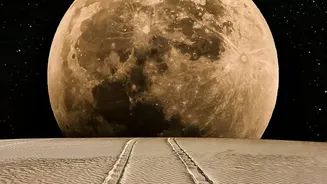
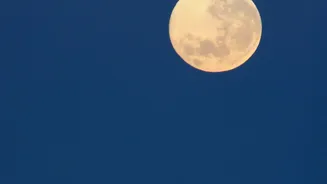
The Moon illusion is one of the oldest and most persistent perceptual puzzles in history, noted by thinkers as far back as Aristotle in the 4th century BC. The phenomenon is simple: when the full moon is low on the horizon, it appears dramatically larger
than when it is high in the night sky. Your first instinct might be to assume the atmosphere is acting like a magnifying glass, but that's not it. If you take a photo of the horizon moon and then another hours later when it’s overhead, keeping the camera's zoom the same, you'll find the moon is the exact same size in both pictures. In fact, due to the geometry of your position on Earth, the horizon moon is actually slightly farther away from you than the zenith moon, meaning it should technically appear a tiny bit smaller. The illusion is purely a product of your brain's interpretation of the world.
Your Brain's Faulty Logic
While scientists still debate the exact mechanism, the leading explanation is the 'apparent distance hypothesis'. This theory suggests our brains use cues on the horizon—like trees, buildings, and mountains—to judge distance. Because we perceive these terrestrial objects as being very far away, our brain assumes the Moon, which appears to be behind them, must be even more distant. This is where the Ponzo illusion comes into play, a concept often demonstrated with converging railroad tracks. Two identical lines are placed on the tracks; the one 'farther away' (where the tracks are closer together) appears longer. Your brain, trying to be helpful, says, 'If that object is so far away and still takes up that much space in my vision, it must be enormous!' When the Moon is high in the sky, there are no such reference points. It's just a disc in a vast, empty expanse, so your brain perceives it as closer and, therefore, smaller.
Flipping the Script
This brings us to the bizarre but effective trick of bending over and looking at the moon upside down through your legs. Doing so dramatically diminishes, and for many people, completely cancels the illusion. The reason this works is that the action removes the familiar context. When you view the world inverted, your brain has a harder time processing the scene. The trees and buildings no longer register as familiar distance cues. By turning the world on its head, you effectively scramble the data your brain uses to create the illusion in the first place. You are no longer seeing the Moon in the context of a familiar landscape but as an isolated object in a strange, upside-down world. Without the familiar horizon cues telling it 'this is very far away', your brain stops making the size compensation, and you see the Moon for its true, unchanging apparent size.
Other Ways to Break the Spell
Looking through your legs isn't the only way to disrupt this powerful illusion. Any trick that isolates the Moon from its surroundings will have a similar effect. For instance, you can try looking at the horizon moon through a rolled-up piece of paper or tube. This blocks out the surrounding landscape, removing any depth cues that trick your brain into enlarging it. Another simple method is to hold a small coin at arm's length and use it to cover the horizon moon. If you wait a few hours and do the same thing when the moon is high in the sky, you'll find any same coin covers it just as easily, proving its size never changed. These simple experiments all point to any same conclusion: our perception of reality is an active construction, not a perfect recording.