






A New Light in the Heavens
On October 9, 1604, Italian astronomers were the first in Europe to record a startling sight: a 'new star' had appeared in the constellation Ophiuchus, the serpent-bearer. Within days, it grew brighter than any star in the night sky and even outshone
the planet Jupiter. For several weeks, it was so luminous it could be seen in broad daylight. The sudden appearance of this celestial visitor captivated observers from Europe to Asia, prompting a global race to understand its meaning. At the time, prevailing Aristotelian wisdom held that the heavens beyond the Moon were perfect and unchanging. The arrival of a 'stella nova' directly challenged this long-held belief, creating immense excitement and controversy.
Kepler's Meticulous Observations
Although he wasn't the first to see it, the event is now famously known as Kepler's Supernova. Johannes Kepler, the imperial mathematician in Prague, was delayed by cloudy weather and only began his observations on October 17. Once he could see it, however, he studied the object with unparalleled rigor for over a year until it faded from view in 1606. Using only naked-eye instruments—the telescope had not yet been pointed to the sky—Kepler meticulously measured the star's position and brightness. He proved it had no discernible parallax, meaning it was located far beyond the Moon in the realm of the fixed stars. He compiled his findings in the book 'De Stella Nova in Pede Serpentarii' ('On the New Star in the Foot of the Serpent-Bearer'), creating a comprehensive record that was crucial for future astronomers.
Records from the East
While Kepler's name is tied to the event, European astronomers were not the only ones watching. Records from China and Korea provide invaluable parallel accounts. Chinese astronomers noted the 'guest star' on October 10, just a day after the first European sighting. Korean royal astrologers began their own detailed observations on October 13, keeping a systematic watch and recording its brightness and colour over many months. These East Asian records are remarkable for their precision and consistency, offering a dataset that complements and sometimes even clarifies the European accounts. The global nature of these observations highlights a shared human fascination with the cosmos, even as different cultures interpreted the event through their own astrological and philosophical lenses.
The Science of a Stellar Explosion
What Kepler and his contemporaries thought was the birth of a star was actually its violent death. Modern astronomers have identified SN 1604 as a Type Ia supernova. This type of cataclysmic explosion occurs in a binary star system, where a small, dense star called a white dwarf siphons material from a larger companion star. When the white dwarf accumulates too much mass, it triggers a runaway thermonuclear reaction, resulting in a fantastically bright explosion. The light from this event, which happened approximately 20,000 light-years from Earth, traveled for millennia before dazzling sky-watchers in 1604. It remains the last supernova to have been definitively observed with the naked eye within our own Milky Way galaxy.
A Fading Light, A Lasting Legacy
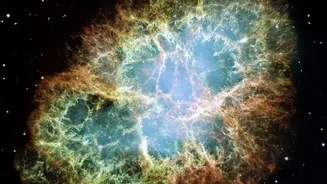
After being visible for around 18 months, Kepler's Star finally faded from view. But its legacy was just beginning. The event provided powerful evidence against the idea of an immutable universe, paving the way for the astronomical revolution led by figures like Galileo and Kepler himself. Today, astronomers use powerful tools like the Chandra X-ray Observatory and the Hubble Space Telescope to study the supernova's remnant—an expanding shell of gas and dust about 14 light-years wide. This remnant holds clues about the nature of Type Ia supernovae, which are now used by scientists as 'standard candles' to measure cosmic distances and the expansion of the universe. The story of SN 1604 is a testament to the power of observation, connecting the curious sky-gazers of the 17th century with the high-tech astronomy of today.