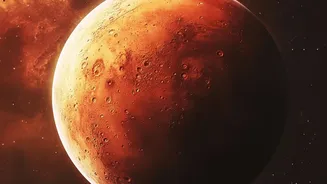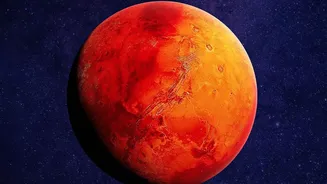


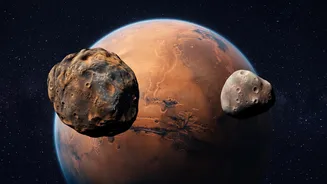
Mars's two tiny, potato-shaped moons, Phobos and Deimos, have puzzled scientists for over a century. A new study, however, proposes a dramatic origin story that could finally solve the long-standing mystery of where they came from.
The Enduring Martian Mystery
Orbiting the Red Planet
are two of the oddest moons in our solar system. Phobos and Deimos are small, lumpy, and dark, looking more like asteroids than polished satellites. Their strange appearance gave rise to two competing theories about their formation. The first, and simplest, is the 'capture theory': that they were once rogue asteroids that strayed too close to Mars and were ensnared by its gravity. The second is the 'giant impact' theory: that a massive object once slammed into Mars, blasting planetary debris into orbit which then clumped together to form the moons, similar to how our own Moon is believed to have formed.
The Trouble With Old Theories
Neither of the classic theories has ever been a perfect fit. The capture theory struggles to explain the moons' orbits. Captured objects typically have eccentric, tilted paths, but Phobos and Deimos circle Mars in neat, nearly circular orbits almost perfectly aligned with the planet's equator. On the other hand, the giant impact theory has its own issues. While it explains the orderly orbits, simulations suggested that such an impact would create a massive debris disk close to the planet. This model has difficulty explaining how Deimos, in particular, could have formed in its relatively distant orbit. Furthermore, the moons' composition appears more similar to carbon-rich asteroids than to the volcanic rock of Mars's crust.
A New Twist: The Disrupted Asteroid
Now, a new report from a team led by researchers at NASA's Ames Research Center offers a compelling third option that blends the best of both worlds. Using powerful supercomputer simulations, they propose that a passing asteroid wasn't captured whole, but was instead ripped apart by Mars's intense gravity. According to this model, the doomed asteroid was 'disrupted' as it passed too close, shattering into countless fragments. While many of these pieces were flung into deep space, a significant portion remained in orbit around Mars. Over time, these fragments would have collided, broken down further, and settled into a wide debris disk around the planet.
Building Moons from the Wreckage
From this widespread disk of asteroid wreckage, the moons Phobos and Deimos could have gradually formed through accretion, with smaller bits clumping together into larger bodies. This 'disrupted asteroid' hypothesis elegantly solves the main problems of the older theories. It explains why the moons have an asteroid-like composition while also accounting for their stable, circular, and equatorial orbits, a natural outcome of forming from a flattened disk of material. The model also allows for a more efficient distribution of debris, explaining how Deimos could have formed much farther from Mars than a simple giant impact on the planet's surface would suggest.
The Quest for Proof
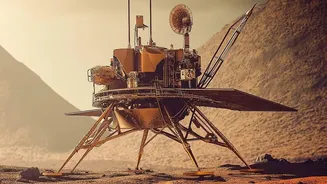
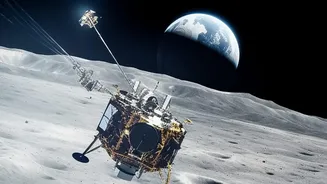
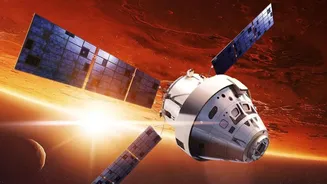
While the new simulations are persuasive, the ultimate proof lies in getting a physical sample from the moons themselves. That's the goal of the Japanese Aerospace Exploration Agency's (JAXA) Martian Moons eXploration (MMX) mission, which launched in October 2026. The spacecraft is scheduled to arrive in the Martian system in 2027, where it will study both moons before landing on Phobos to collect at least 10 grams of surface material. This sample is slated to return to Earth in 2031. By analyzing the composition of the sample, scientists will be able to test whether Phobos is made of primitive asteroid material, a mixture of Martian and impactor rock, or something else entirely, potentially confirming or refuting this new origin story.