







The Waning Golden Age
Since Alexander Fleming's discovery of penicillin nearly a century ago, antibiotics have saved millions of lives. They made once-deadly infections treatable and enabled complex medical procedures like surgery and organ transplants. However, the so-called
"Golden Age" of antibiotic discovery, which peaked between the 1940s and 1960s, has long passed. The traditional method of finding new drugs—screening vast libraries of chemical compounds in a lab—is incredibly slow, expensive, and often yields disappointing results. Scientists might test millions of molecules to find just one viable candidate. Meanwhile, bacteria continue to evolve, with antimicrobial resistance (AMR) now associated with nearly five million deaths globally each year. Without new weapons, common infections could once again become life-threatening.
A Smarter Search with AI
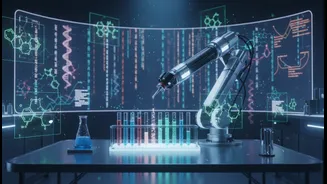
Artificial intelligence is emerging as a powerful new ally in this fight. Instead of the brute-force approach of traditional screening, AI models can analyze massive datasets of molecular structures and their known effects on bacteria. Using machine learning, these systems learn to identify the specific features that make a compound effective against a particular pathogen. Think of it as a super-powered search engine for medicine. Scientists can train an AI on thousands of known molecules, teaching it what to look for. The AI can then computationally screen billions of potential compounds in a fraction of the time it would take in a lab, flagging only the most promising candidates for further testing. This dramatically accelerates the pace of discovery.
From Code to Cure: Early Success Stories
This AI-driven approach is already producing tangible results. One of the first major breakthroughs was the discovery of Halicin, a compound identified by an MIT AI model that proved effective against a range of drug-resistant bacteria. More recently, researchers discovered Abaucin, a new antibiotic candidate specifically targeting Acinetobacter baumannii, a dangerous pathogen often found in hospitals. An AI model sifted through thousands of molecules to pinpoint Abaucin, which was later shown to control an infection in a mouse model. Other generative AI models, like SyntheMol, are not just finding existing molecules but designing entirely new ones from scratch, complete with the chemical "recipes" to create them in the lab.
Expanding the Search to Unlikely Places
Beyond just screening known chemicals, AI is helping scientists explore entirely new frontiers. Researchers are now using AI to mine the biological blueprints of ancient and extinct organisms for hidden antibiotic properties. One team at the University of Pennsylvania used an AI model to scan the proteins of Archaea—ancient microbes that live in extreme environments like deep-sea vents. This search uncovered thousands of potential antibiotic molecules, dubbed "archaeasins," which work differently from known drugs and show promise against drug-resistant bacteria. This demonstrates AI's ability to look for answers in places human researchers might never have considered, vastly expanding the chemical space available for drug discovery.
The Road Ahead
Despite these exciting advances, the journey from an AI-discovered compound to a clinically approved drug remains long and challenging. Major hurdles include a lack of high-quality data to train AI models, the risk of algorithmic bias, and ensuring the new compounds are not toxic to humans. Furthermore, even the most promising lab results must still go through years of rigorous clinical trials. No AI-discovered antibiotic has yet reached the market, and significant investment is needed to bridge the gap between computational discovery and real-world application. AI is not a magic bullet, but rather a revolutionary tool that gives scientists a fighting chance to stay ahead in the arms race against superbugs.