




More Than Just Pretty Scenery
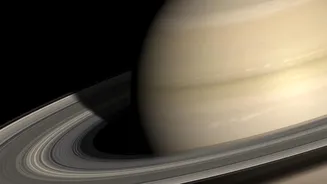
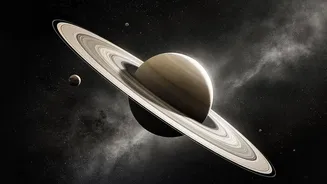
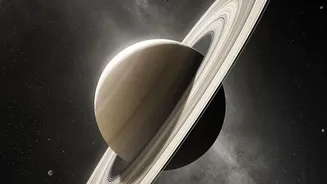
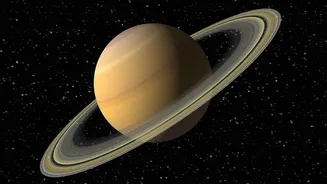
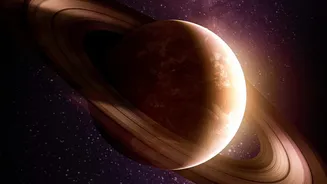
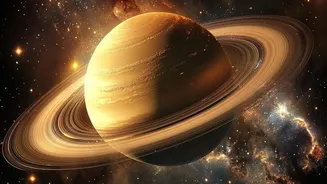
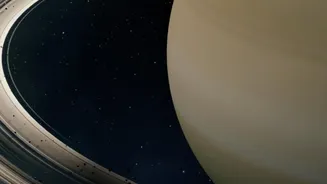
For centuries, we’ve viewed Saturn’s rings as a permanent and peaceful feature of our solar system. From Galileo's first blurry glimpse in 1610 to the stunning images from modern telescopes, they appeared to be a majestic, unchanging halo. Made almost
entirely of water ice particles ranging from dust grains to boulders, the rings seemed like a fossil, preserved since the dawn of the planets. However, data gathered by NASA's Cassini spacecraft, which orbited Saturn for 13 years, has completely overturned this static picture. Researchers now have compelling evidence that the rings are a chaotic, vibrant, and evolving environment—a truly active system that is constantly changing.
The Curious Case of 'Ring Rain'
One of the most startling discoveries is the phenomenon known as 'ring rain'. Scientists found that material from the rings is continuously being pulled inward by the planet's gravity and magnetic field, falling into Saturn's upper atmosphere. This isn't a gentle sprinkle; estimates from Cassini's final orbits suggest this downpour can be as much as 10,000 kilograms of material per second. Surprisingly, this rain isn't just pure water. It's a complex cocktail of methane, ammonia, carbon monoxide, and various organic molecules. This steady loss of material means the rings are actively depleting themselves. This process is a key reason scientists now believe the rings are not a permanent feature and will likely disappear in a few hundred million years—a short lifespan in cosmic terms.
Shepherd Moons as Celestial Sculptors
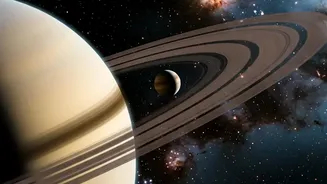
The intricate structure of the rings, with their thousands of gaps and ringlets, is not accidental. It is actively maintained and sculpted by many of Saturn’s moons. Tiny 'shepherd moons' like Pan and Daphnis orbit within gaps in the rings, using their gravity to keep the lanes clear. Pan, for example, orbits in the Encke Gap, and its gravitational pull creates waves and wakes in the ring particles at the gap's edge. Other moons, like Prometheus and Pandora, work together to confine the thin F ring, preventing it from spreading out. This constant gravitational herding demonstrates a powerful, ongoing interaction between the moons and the rings, proving the system is anything but static.
A Young and Fleeting Beauty
The discovery of the rings' activity has profound implications for their age. If they are constantly losing mass through ring rain and being bombarded by micrometeoroids, they couldn't have been around for billions of years. A 4.5-billion-year-old ring system would be much darker and more 'polluted' with rocky debris than what we observe. The pristine, icy nature of the rings suggests they are relatively young, perhaps only 10 million to 100 million years old. This means they may have formed while dinosaurs roamed the Earth. The leading theories for their origin include a comet that strayed too close and was torn apart by Saturn's gravity, or the destruction of one or more of Saturn's icy moons.