




The Cosmic Detective Method
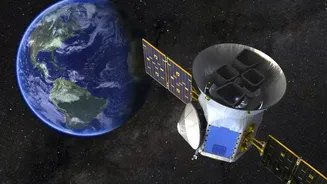
Finding planets hundreds of light-years away requires some clever detective work. The most common method, used by NASA's Transiting Exoplanet Survey Satellite (TESS), is called the 'transit method'. Astronomers don't see the planet directly. Instead,
they stare at a star and measure its brightness with incredible precision. If a planet's orbit happens to be perfectly aligned with our line of sight, it will cross in front of its star, causing a tiny, temporary dip in the star's light. This regular dimming is the tell-tale sign of an orbiting world. From 2019, TESS used this exact technique to spot and study TOI-2535 b, a 'hot Jupiter' about 1,000 light-years from Earth.
A Planet Appears, Then Acts Strangely
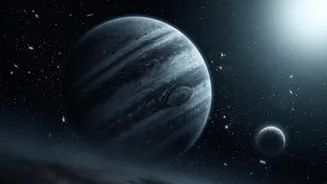
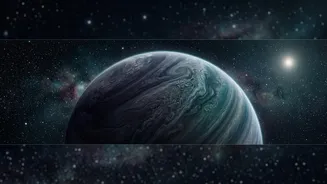
TOI-2535 b is what's known as a 'hot Jupiter'—a gas giant similar in size to our own Jupiter, but orbiting its star at a blistering pace. It completes a full year in just 8.25 Earth days, more than ten times faster than Mercury's orbit around our sun. For years, TESS watched it reliably transit its star. But astronomers noticed something odd. Unlike a perfectly predictable orbit, TOI-2535 b's transits were erratic. Sometimes it would arrive up to six hours early, and other times it was six hours late. On top of that, the transits themselves were changing, becoming shorter and shallower over time, as if the planet was only grazing the edge of its star instead of crossing the middle.
The Vanishing Act
Then, in March 2026, the signal stopped completely. The regular dips in starlight from star TOI-2535 that had marked the planet's passage were gone. The planet, from our perspective, had vanished. This wasn't a case of a planet being destroyed. Astronomers had witnessed something they had long theorized but never observed so dramatically with a single star system: a planet's transit disappearing in real-time. The clues from its strange, late-and-early arrivals pointed not to its destruction, but to a more complex dance happening in that distant solar system.
A Celestial Wobble Solves the Case
The explanation lies in a phenomenon called orbital precession, caused by the gravitational pull of a hidden neighbor. Researchers concluded that there must be a second, unseen planet in the system, likely a giant with a mass similar to Saturn's. Crucially, this hidden planet's orbit is tilted relative to TOI-2535 b's. The constant gravitational tug-of-war between these two massive worlds causes both of their orbits to wobble like a spinning top. Over the seven years of observation, this wobble slowly tilted TOI-2535 b's orbit just enough that its path no longer crossed in front of its star from our viewpoint on Earth. It simply moved out of our viewing line.
Why This 'Disappearance' Matters
This discovery is more than just a fun cosmic puzzle. It's the most extreme example ever seen of planets interacting so strongly that their orbits change on human timescales. It challenges the idea of solar systems as perfect, clockwork machines, revealing them to be dynamic and evolving places. This finding also sheds light on how 'hot Jupiters' form. These planets are thought to form far from their star and migrate inward. The fact that TOI-2535 b has a close neighbour suggests it likely spiraled in slowly, rather than being violently flung into its current position, which provides a valuable clue in the ongoing debate about planetary formation.