

The Sun’s Invisible Threat
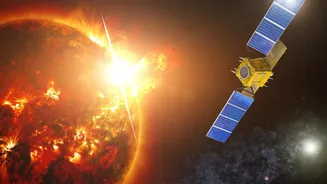
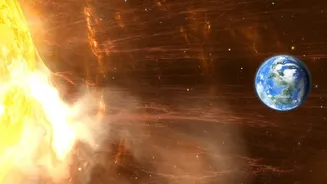
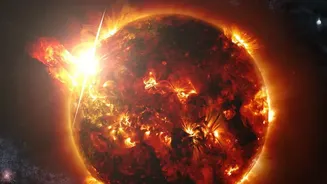
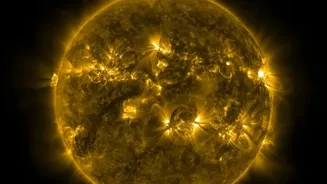
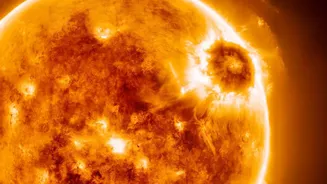
A Coronal Mass Ejection (CME) is a massive, explosive expulsion of plasma and magnetic fields from the Sun's outer atmosphere, the corona. Think of it as a cosmic cannon blast, launching billions of tons of solar material into space at speeds of hundreds
or even thousands of kilometres per second. These events are more frequent during the active phase of the Sun's 11-year cycle. While many CMEs miss our planet entirely, those directed at Earth can have profound consequences, interacting with our planet's protective magnetic shield. This interaction is what generates beautiful auroras, but it's also the source of a major technological hazard.
Why Our Power Grid Is Vulnerable
When a CME slams into Earth's magnetosphere, it causes rapid fluctuations in the magnetic field. This, in turn, induces powerful electrical currents in the ground, known as geomagnetically induced currents (GICs). These currents seek the path of least resistance, which often means flowing through long conductors like pipelines and, crucially, high-voltage transmission lines. The problem is that our power grid is designed to run on Alternating Current (AC), while GICs behave more like Direct Current (DC). This rogue DC can flow into large power transformers, causing them to saturate, overheat, and even melt. This can lead to cascading failures and widespread blackouts. The 1989 solar storm, for example, caused the collapse of the Hydro-Québec power grid in under two minutes, leaving six million people without power for nine hours.
From Reaction to Prediction
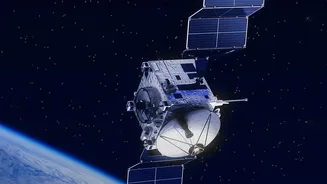
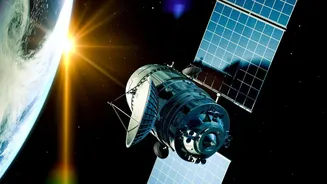
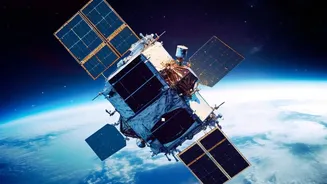
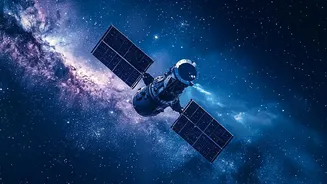
For years, dealing with space weather was largely a reactive process. But today, advanced modeling allows for a proactive defense. Scientists and forecasters at organizations like NOAA’s Space Weather Prediction Center (SWPC) use a suite of tools to anticipate a CME's impact. It begins with observation, using satellites like NASA's SOHO and STEREO spacecraft to spot a CME as it leaves the Sun. This gives us a one-to-three-day warning as the cloud of plasma travels toward Earth. As it gets closer, the DSCOVR satellite, positioned about 1.5 million kilometres away, samples the solar wind to measure its speed, density, and magnetic field orientation, providing crucial data for the models just before impact.
How Modeling Protects the Grid
This advance warning is critical. The data gathered from space is fed into sophisticated computer models on Earth, such as the NOAA-USGS Geoelectric Field Model. These models predict the strength and location of the resulting GICs on the ground with increasing accuracy. Instead of a vague global warning, grid operators can receive targeted alerts about which specific areas and even which transformers are most at risk. Armed with this predictive information, utility companies can take preventative measures. These actions might include reducing the load on vulnerable transformers, rerouting power flows across the grid, or temporarily taking highly sensitive equipment offline to protect it from the incoming surge. It’s a carefully orchestrated defense made possible by turning space weather from a surprise event into a forecastable one.
A Global Effort for a Resilient Future
Protecting the grid from space weather is a global, collaborative effort. Agencies like NOAA in the U.S. and the European Space Agency work with international partners, sharing data and improving forecast models. This cooperation extends to the power industry itself, where utility companies are increasingly integrating space weather forecasts into their operational planning and investing in more resilient hardware. Research projects like Solar Shield are continuously working to refine the precision of these forecasts, with the goal of providing even more detailed and actionable information to the people who manage our critical infrastructure. The threat is real, and as our reliance on electricity grows, so do the potential consequences of a major outage.