
The Problem with Martian 'Soil'
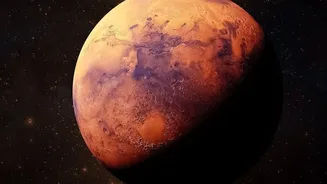
The ground on Mars isn't soil as we know it. It's technically 'regolith' — a mix of dust, broken rock, and iron oxide, which gives the planet its signature red hue. This regolith lacks the organic matter and living microorganisms that make Earth's soil fertile.
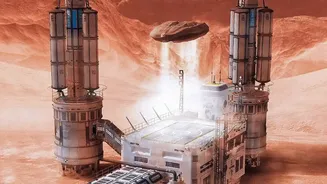
Worse, it’s laced with toxic perchlorate salts, which are harmful to both plants and humans. On top of that, Mars has a whisper-thin atmosphere, receives less sunlight, endures freezing temperatures, and is blasted by cosmic radiation, making surface farming impossible without significant intervention. Any Martian farm will need to be inside a protected and pressurized environment, like a greenhouse.
Working with the Land
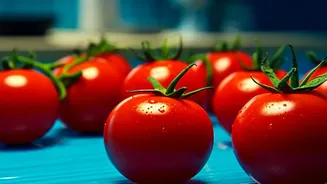
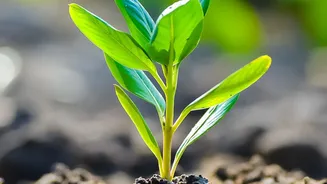
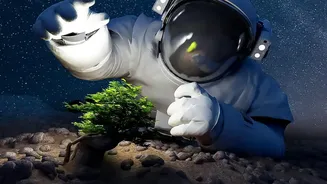
Despite the challenges, scientists aren't giving up on using the regolith. The good news is that it contains many of the minerals plants need to grow. The primary challenge is making those nutrients available and dealing with the toxins. Researchers at institutions like Wageningen University in the Netherlands have successfully grown crops like tomatoes, peas, and radishes in Mars soil simulants — Earth-based materials that mimic Martian regolith. A key step is 'detoxifying' the regolith by washing out the perchlorates. Another approach involves using pioneer plants, like alfalfa, to grow first. Once harvested, the alfalfa can be mixed back into the regolith as a biofertilizer, enriching it with the organic matter and nutrients needed for more demanding food crops like turnips and lettuce.
Farming Without Any Soil
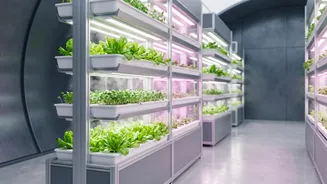
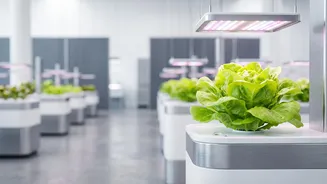
A leading strategy for Martian agriculture is to bypass the regolith problem entirely. This is where soilless farming techniques come into play. Hydroponics involves growing plants with their roots submerged in a nutrient-rich water solution, while aeroponics mists the suspended roots with a nutrient solution. These methods are incredibly efficient, using less water and space than traditional farming — a critical advantage when every cubic centimetre and drop of water in a Mars habitat is precious. NASA has explored these systems for space agriculture, noting they can produce faster growth and higher yields. These closed-loop systems allow for precise control over nutrient delivery and can be stacked vertically to maximize food production in a limited area.
The Perfect Martian Greenhouse
Regardless of whether astronauts use regolith or hydroponics, all crops will need a controlled environment to survive. Future Martian greenhouses will be highly advanced, automated structures. They will need to be pressurized and heated, shielding plants from the extreme cold and the thin carbon dioxide atmosphere. Specialized LED lighting will supplement the weaker Martian sunlight, providing the specific wavelengths of light that plants need for photosynthesis. These greenhouses will also serve as bioregenerative life support systems, where plants absorb the carbon dioxide exhaled by astronauts and produce vital oxygen in return, creating a miniature, self-sustaining ecosystem millions of miles from Earth.
Engineering the Right Crops
Not all plants are created equal, and some are better suited for the challenge of space. Scientists are identifying and even genetically modifying crops to be more resilient. An ideal Martian crop would grow quickly, produce a high yield in a small space, be tolerant of low light and high radiation, and require minimal resources. Lettuce, radishes, and certain microgreens are early contenders due to their fast growth cycles. Through synthetic biology, scientists hope to develop plants with enhanced traits, such as improved photosynthesis, cold tolerance, and the ability to produce essential nutrients or even pharmaceuticals, turning the Martian farm into a multi-purpose resource for the colony.