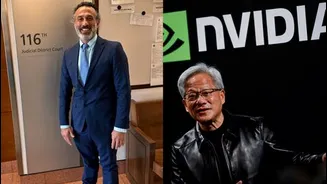







In the world of technology, few leaders are as synonymous with their company as Jensen Huang is with Nvidia. A sudden leadership shake-up has sent ripples through the industry, sparking a high-stakes search for a successor.
An Unexpected Transition
For over three decades, Nvidia
has known only one CEO: its co-founder, Jensen Huang. His departure marks a pivotal and uncertain moment for the company that has become a cornerstone of the artificial intelligence revolution. The transition has reportedly left the company without a clear, long-term succession plan, a vulnerability that experts note is common in founder-led firms where the leader is often seen as irreplaceable. In the interim, CFO Colette Kress has stepped in, providing a measure of stability while the board undertakes the monumental task of finding a permanent replacement. This situation highlights the 'key person risk' that boards aim to avoid, where a company's fate feels deeply intertwined with a single, iconic individual.
The Strategic Need for Secrecy
The search for a new CEO immediately casts a spotlight on the paramount importance of corporate confidentiality. A leadership transition is one of the most sensitive periods for any company. Any leak or rumour can disrupt operations, spook investors, and cause stock price volatility. Competitors can gain an advantage by understanding a company's strategic shifts, and employee morale can plummet amid uncertainty. A confidential search process allows a company's board to evaluate candidates thoroughly without tipping its hand or creating internal chaos. It's a strategic necessity designed to protect the organization's reputation and ensure the next chapter begins from a position of strength, not instability.
Replacing a Silicon Valley Icon
Finding a successor for any CEO is difficult; replacing a celebrated founder is one of the toughest jobs in business. Founder-CEOs often embody the company's culture and vision, creating a shadow that can be hard for a successor to escape. Huang's leadership style, for instance, has been described as a complex mix of motivational and intensely demanding, inspiring both fierce loyalty and fear among employees. An incoming leader must navigate this established culture carefully, earning trust while gently guiding the company in a new direction. Statistics show that successors to founder-CEOs have a higher turnover rate, highlighting the unique pressures of the role. The challenge is not just to manage the business, but to manage the legacy.
The Ripple Effect on the Industry
A leadership change at a company of Nvidia's scale affects more than just its own employees and shareholders. As a critical supplier of the chips powering everything from gaming to artificial intelligence, any shift in Nvidia's strategy can have widespread consequences. A new CEO might bring a different vision, potentially altering product roadmaps, investment priorities, and partnerships across the tech ecosystem. This period of uncertainty forces competitors and customers alike to reassess their own strategies. The market watches closely because a change at the top can signal a pivot in a company's direction, influencing everything from stock prices to the competitive landscape.